Flying with a dog, cat, or other companion pet requires more than buying a ticket and choosing a carrier. You must evaluate the animal, confirm the operating airline’s policy, meet destination and transit requirements, and prepare for the pet’s return to the United States.
These checks matter because airline procedures, country rules, aircraft assignments, weather limits, and U.S. import requirements can change between trips. The practical decision is whether the entire itinerary works for the specific pet, not whether one airline or one document appears acceptable. This guidance was researched on July 31, 2026. Recheck all time-sensitive requirements before booking, before departure, and after any itinerary change.
Start With the Pet and Route
Begin with the pet’s species, age, health and readiness, temperament, identification, breed-related considerations, route, and planned return. Create a complete itinerary record before comparing fares or buying a nonrefundable ticket around the animal.
Assess the animal
Kennel suitability and animal readiness are separate questions. A carrier may meet a size or construction requirement while the journey remains unsuitable for a particular animal because of age, health concerns, temperament, heat exposure, or other individual factors. A veterinarian must address the animal’s health, and the airline makes its own transportation decision.
USDA Animal and Plant Health Inspection Service, or APHIS, states in its air-travel preparation guidance that dogs and cats covered by its framework must be at least 8 weeks old and fully weaned. The same guidance discusses breed-related considerations, including the increased heat and breathing risks that can affect many short-nosed, or brachycephalic, dogs and cats. These points identify planning concerns. They do not provide veterinary clearance or predict whether a particular airline will accept an animal.
Record the following details:
- Species, breed or mix, age, sex, and weight
- Microchip number and current contact information
- Rabies vaccination history and expiration date
- Proposed travel method: cabin, hold where offered, or cargo
- Temperament and handling considerations
- Any breed, age, seasonal, or route restrictions identified by the operating airline
- Intended destination, transit points, and U.S. return airport
Do not present a companion pet as a service animal to obtain a different travel arrangement. Companion pets, emotional support or comfort animals, service animals, and service animals in training may follow different airline and legal frameworks. The Centers for Disease Control and Prevention distinguishes ordinary pet travel from service-animal considerations. Service-animal accommodation is outside the scope of companion-pet planning.
Map every segment
A flight itinerary is not complete when it lists only the first departure and final destination. Record each flight number, operating carrier, aircraft when available, departure and arrival airport, connection time, and the way the pet will be handed over between segments.
Also identify every country where the pet may:
- Clear customs
- Leave the airport
- Change airports
- Stay overnight
- Be collected and checked in again
- Travel under a separate airline or cargo process
For example, an itinerary marketed by one airline may include a flight operated by another carrier. The marketing airline’s pet policy may not apply to the operating carrier, aircraft, or airport handling process. A connection that looks like an airport-only transfer may also require customs clearance or a change of terminal procedure.
Include the intended U.S. arrival airport and the dog’s country history for the six months before returning. That history can affect the applicable U.S. import pathway even when the dog originally departed from the United States.
Confirm the Operating Airline
Contact the operating airline before booking around the pet. Airline acceptance is independent of veterinary paperwork and government permission to enter a country. A valid health certificate does not guarantee transport, and an airline confirmation does not establish border eligibility.
Airline policies can vary by species, size, route, aircraft, season, weather, airport, cabin capacity, and travel method. The CDC’s pet-travel safety guidance directs travelers to follow airline policies and keep pets in approved carriers. Check every operating carrier, including carriers used only for a connecting segment.
Check the approved travel method
Ask the airline, in writing when possible, about:
- Eligible species and breeds
- Cabin, hold, and cargo options
- Pet capacity on the specific flight
- Maximum pet-and-carrier dimensions and weight
- Carrier or kennel construction requirements
- Route, aircraft, airport, seasonal, and weather restrictions
- Required pet reservations or capacity-controlled slots
- Check-in time and airport handoff location
- Required health or import documents
- Procedures for delays, cancellations, aircraft substitutions, and rebooking
Do this before locking in a fare that cannot easily be changed. A passenger ticket may remain valid after an aircraft or operating carrier changes, while the pet reservation may not transfer automatically.
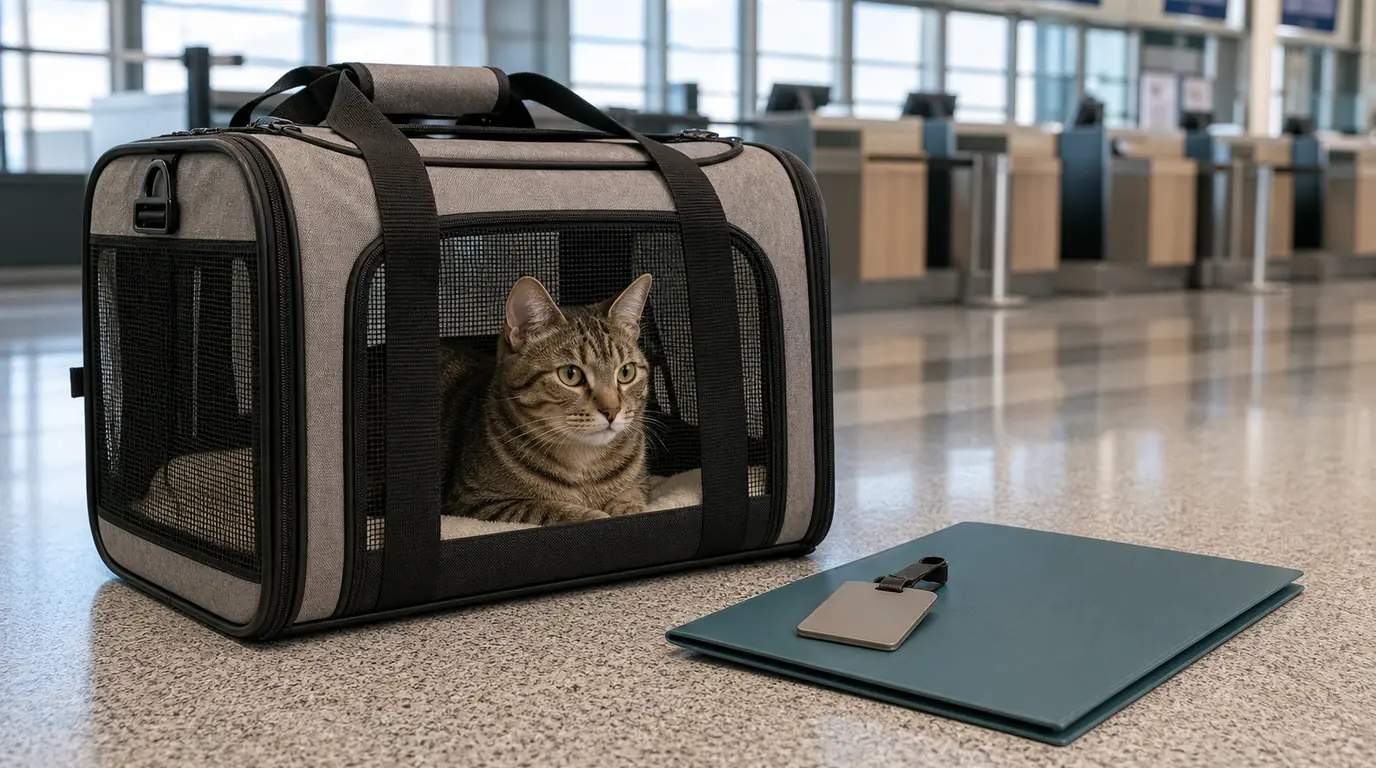
When an airline accepts a pet in the cabin, the carrier generally must fit under the seat in front of the passenger and remain secured according to airline policy. The Federal Aviation Administration’s pet-travel guidance explains that the container is treated as carry-on baggage and must not block aisle access or be placed in an overhead bin. Airline instructions control the exact handling procedure.
Cabin travel also does not mean the pet can be removed whenever the passenger wishes. The carrier must be properly stowed before departure and during aircraft movement, takeoff, and landing under applicable airline and aviation procedures.
Match the kennel to the journey
An under-seat cabin carrier is not the same as a hard-sided kennel used for a hold or cargo process. Use the carrier type approved for the actual travel method, then compare it with the airline’s current instructions.
APHIS guidance addresses several kennel features, including appropriate size, sturdy construction, secure fasteners, ventilation, sanitation, leak-proof flooring, attached food and water dishes, labeling, and handling information. A cargo or hold kennel should allow the pet to stand, sit, and turn around comfortably.
The APHIS guidance also identifies these features for the relevant air-transport kennel framework:
- Hard-sided construction with secure fasteners
- Ventilation openings on three sides and the door
- Leak-proof flooring with an unused absorbent pad or collection tray
- No sharp edges or unsafe materials
- A design that permits emergency removal
- Food and water dishes attached so they can be reached without opening the door
- “Live Animal” labels in 1-inch letters on the top and at least one side
- Upright-position arrows and routing information
The APHIS kennel and handling instructions also address feeding and watering information and the applicable certification that food and water were offered within four hours of airport delivery. Airline procedures may add requirements, so do not treat one checklist as universal.
Keep identification details attached to the kennel and with the travel documents. Follow the airline’s instructions for shipping papers that must remain in the kennel pouch. Keep any passenger-held originals accessible rather than placing them in checked baggage. Printed backup copies can help during a disruption, but a copy does not replace an original document when an authority requires an original signed or endorsed form.
Prepare Documents and Borders
Start veterinary and document planning early. International travel can require a combination of microchip identification, vaccinations, laboratory tests, treatments, health certificates, government endorsement, import permits, advance notice, and approved arrival procedures.
Start veterinary planning
USDA advises travelers exporting a dog or cat to contact a USDA-accredited veterinarian as soon as travel is planned. The veterinarian can help identify the destination’s requirements and schedule applicable examinations, vaccinations, tests, treatments, and certificates. Some documents may then require USDA endorsement.
The veterinarian’s timing must match the destination’s rules. A certificate can have a limited period for signing, endorsement, and use, and the acceptable timing for a treatment or test may be narrower than the overall travel window. Do not assume that a routine appointment shortly before departure will satisfy every requirement.
Keep a dated record of:
- Microchip number and readability
- Rabies vaccination date and expiration
- Required tests and treatments
- Examination date
- Health-certificate form and signature date
- USDA endorsement requirement and submission timing
- Import permit or advance-notice requirement
- Approved arrival airport or inspection procedure
- Who carries the original documents
A general 10-day health-certificate reference is not a universal international rule. CDC may recommend a veterinarian-issued certificate within 10 days of departure as a general air-travel preparation measure, while the destination country may require a different official form, endorsement, treatment, or timing window. The exact destination rule controls.
Check destination entry
The destination country sets its own entry requirements. Verify the current rules for the specific species, travel date, arrival airport, and country of origin. APHIS warns that country requirements can change and should be checked each time a traveler plans to take a pet abroad.
Organize the destination review around seven questions:
- Does the country cover this species and type of companion animal?
- What identification or microchip standard applies?
- Which vaccinations, tests, treatments, or waiting periods are required?
- Which certificate must a veterinarian complete?
- Does a government authority need to endorse the certificate?
- Are permits, advance notices, approved ports, or inspection appointments required?
- What timing applies to each document and medical step?
Use the travel document checklist as a dated record of document names, issue dates, contacts, and airline confirmations. It is a recordkeeping aid, not a compliance validator.
Check transit separately
A transit country may matter even when it is not the final destination. APHIS asks travelers to identify countries where the pet stops for customs clearance or after leaving an airport or seaport. That means a connection deserves its own review when the pet must clear customs, leave the airport, stay overnight, change airports, or be collected and rechecked.
Ask the airline exactly how the pet moves through the connection. A protected airside transfer may differ from a process that requires the passenger to collect the animal and check it in again. If a delay creates an unplanned overnight stay or a reroute through another country, the original compliance analysis may no longer apply.
For each transit point, confirm whether the pet remains airside, whether customs clearance occurs, who handles the animal, and whether a separate transit certificate, permit, notification, or inspection applies. Do not assume that the destination’s documents automatically cover transit.
Plan U.S. Return and Disruptions
Build the return plan before leaving the United States. A U.S.-origin pet can still face current import requirements when it comes home. Documents used for export do not automatically establish eligibility for U.S. re-entry.
Build the dog return path
The CDC is the primary federal authority for dogs entering or returning to the United States. According to the CDC dog-import FAQ, every dog entering or returning to the United States needs a CDC Dog Import Form receipt.
The remaining requirements depend on the dog’s recent travel history and current facts. Record the countries where the dog has been during the six months before U.S. arrival, whether the dog appears healthy, its age, microchip status, rabies-vaccination history, and the documents it will carry.
Dogs that have been only in dog-rabies-free or low-risk countries still must meet the current baseline conditions, which include a readable microchip, apparent good health, and a minimum age of 6 months. Dogs that have been in a country classified as high risk for dog rabies may need additional documentation and may be limited to particular U.S. arrival airports or animal-care facilities.
Use the CDC’s current dog-import pathway to identify the applicable category immediately before travel. Recheck the high-risk-country classification because it can change.
Handle high-risk travel history
A dog with recent high-risk-country travel may need rabies-vaccination records, a serology result, additional certification, a reservation at a CDC-registered animal care facility, or arrival at a specified U.S. airport. Depending on the dog’s documentation and vaccination history, the process may include examination, revaccination, and possible quarantine.
For a U.S.-vaccinated dog visiting a high-risk country, the applicable U.S.-issued rabies certification must be completed and USDA-endorsed before departure from the United States. APHIS states that the certification cannot be issued retroactively after the dog has left.
Foreign-vaccinated dogs from high-risk countries can face a different process. CDC may require a reservation at a registered animal-care facility, and the arrival airport on the documentation must match the return plan. A dog without an accepted rabies-serology result may face a 28-day quarantine under the applicable pathway. Confirm the live CDC high-risk dog requirements rather than planning from a previous trip.
Check cats and state rules
Cats follow a different federal return path from dogs. CDC does not require proof of rabies vaccination for cats entering the United States, but it recommends rabies vaccination and notes that the destination state or territory may impose additional requirements.
Federal rules are not the only rules that can apply at the end of the trip. Hawaii and Guam, for example, have locally administered requirements for cats arriving from the U.S. mainland and other locations. Check the destination state or territory through the CDC animal-import information and the relevant local authority.
For dogs and other pets, federal permission does not remove state, territorial, airline, or destination-specific requirements.
Prepare a fallback plan
Keep original documents, printed backups, airline confirmation, microchip details, feeding and watering instructions where applicable, and relevant contacts accessible during the journey. A disruption plan should include acceptable alternate airports and routes, but each alternative must be checked before use.
Recheck the plan if a delay, cancellation, reroute, aircraft substitution, or rebooking changes:
- The operating airline
- Aircraft type
- Travel method
- Transit country or airport
- Overnight location
- U.S. arrival airport
- Customs or animal-care-facility arrangement
Do not accept a replacement itinerary solely because a seat is available. A new route may require a different airline approval, a different transit analysis, or a different U.S. return pathway.
Previous flights are not enough
A pet that completed the same trip before may not qualify for the next one. The airline may have changed its aircraft, capacity, seasonal limits, weather procedures, or route policy. The destination may have changed its documents or timing windows. A dog’s six-month country history, vaccination status, age, or microchip record may also produce a different U.S. return requirement.
Previous experience can help you organize the next trip, but it does not replace a fresh review of the operating airline, every border, and the current U.S. return rules.
What to Check Before Departure
- Check the operating airline first: Confirm the specific pet, carrier, flight, aircraft, route, airport, and travel method before buying a fare around the animal.
- Start veterinary planning early: A USDA-accredited veterinarian can help identify destination tests, treatments, certificates, and endorsement timing, but the destination’s current rules control.
- Separate the pet from the carrier: A suitable kennel does not establish that an individual animal is ready to fly or that an airline will accept it.
- Review every border independently: Destination, transit, and U.S. return requirements can each require different documents, timing, airports, or procedures.
- Build the return and disruption plan before departure: For dogs, track the six-month country history and CDC Dog Import Form, then recheck everything after a reroute or airport change.
FAQ
Does airline acceptance mean my pet can enter the destination country?
No. Airline acceptance covers the carrier’s transportation decision, not government entry permission. Confirm destination documents, transit compliance, veterinary requirements, and the current U.S. return pathway separately.
Is a health certificate enough for international travel?
Usually not. A destination may also require a microchip, vaccinations, tests, treatments, government endorsement, an import permit, advance notice, or an approved arrival procedure. The required form and timing depend on the specific country and pet.
Do I need to check a transit country if I will not leave the airport?
Check the actual connection process. Customs clearance, an overnight stay, an airport change, or collecting and rechecking the pet can make transit-country rules relevant. Ask the operating airline how the animal will move through each connection.
What does my dog need to return to the United States?
Every dog entering or returning to the United States needs a CDC Dog Import Form receipt. Additional conditions depend on the dog’s six-month country history, age, apparent health, microchip, rabies-vaccination history, documents, and sometimes the U.S. arrival airport or animal-care-facility reservation.
Can I complete U.S.-issued rabies certification after my dog leaves?
Not for the applicable U.S.-vaccinated dog pathway involving a high-risk country. The required certification must be completed and USDA-endorsed before departure from the United States and cannot be issued retroactively.
Are companion pets and service animals handled the same way?
No. Companion-pet travel and service-animal accommodation follow different frameworks. Do not use ordinary pet-travel procedures as a substitute for service-animal guidance.