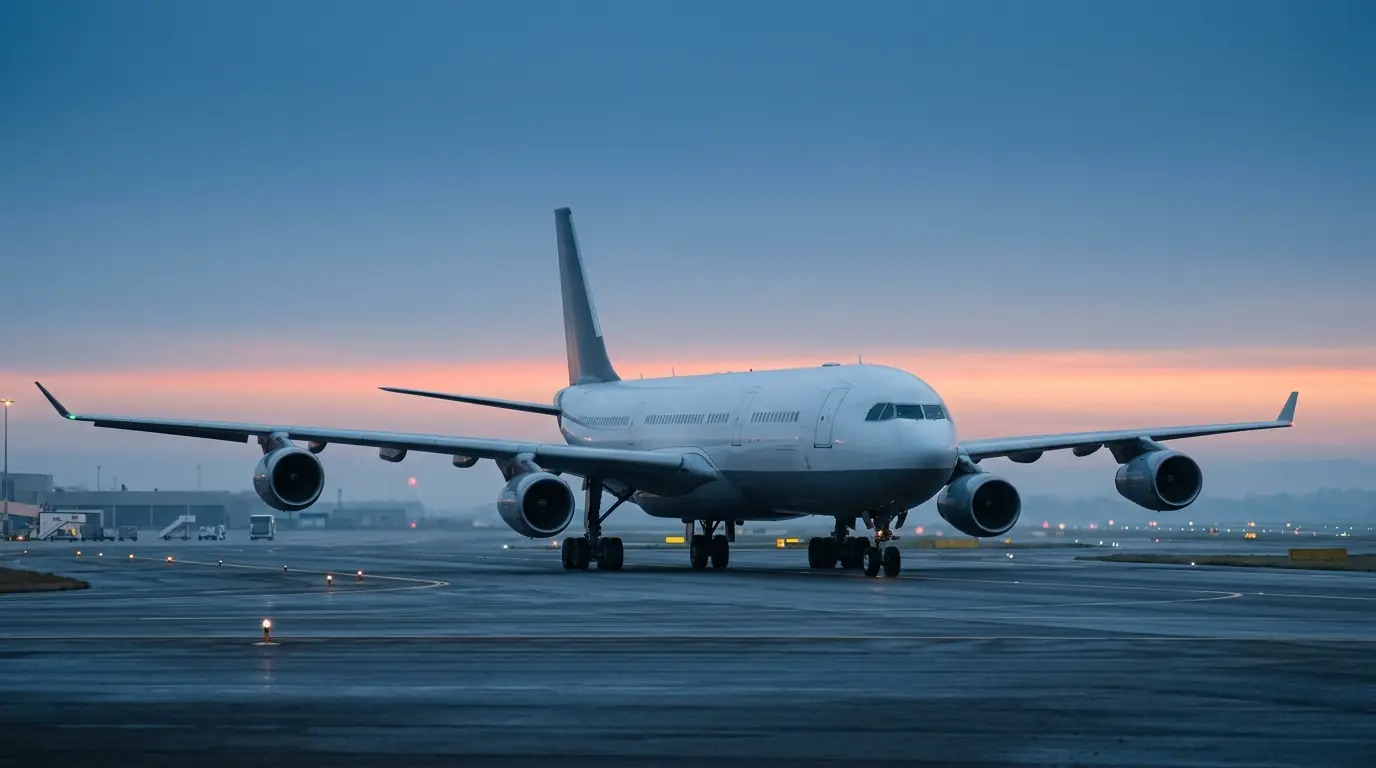
Early jet technology needed more engines to produce the thrust required by very large or long-range aircraft, while twin-engine route limits also shaped where twins could fly. As turbofans improved and extended-operations approvals developed, two engines could do work that had previously required three or four.
A four-engine jet aircraft has four separate jet engines. On the passenger airliners discussed here, that usually means two turbofans beneath each wing. It does not mean four compressor stages inside one engine, and it does not include a four-propeller aircraft simply because it has four powerplants.
The visible count is easy. The reason for it is more interesting. Four engines were never one universal solution to crossing an ocean, carrying a certain number of people, or making an aircraft safe. Designers worked inside the technology, performance, certification, route, and commercial constraints of their period.
Three forces behind the four-engine form
1. The thrust available at the time
The FAA’s ETOPS history explains that early turbine performance required more than two engines to provide the thrust needed by large aircraft on routes where twins were constrained by the 60-minute rule. A large airframe could not simply use a pair of modern high-thrust engines before those engines existed.
Engine capability changed. The FAA says improving jet and turbofan performance eventually allowed manufacturers to reach with two engines performance and range that earlier turbine generations had needed more engines to achieve. This technical change is central: the modern long-range twin is not merely an old four-engine aircraft with two nacelles removed.
2. The aircraft’s intended scale and job
Four engines appeared across very different jobs, from early intercontinental jets to unusually large widebodies. The Smithsonian describes the 747 as a widebody powered by four high-bypass turbofan engines. In its historical comparison with the 707, the museum explains how the larger aircraft lowered seat-mile cost. That is a statement about a specific design and period, not proof that any four-engine aircraft is efficient today.
The A380 represents another scale decision. Airbus lists four Rolls-Royce Trent 900 or four Engine Alliance GP7000 engines and identifies the aircraft as the only full-length double-deck jet airliner. Its engine count belongs to that complete aircraft concept, including its size, structure, systems, and intended capacity.
3. The route framework for twins
Route rules mattered alongside power. The FAA’s historical account describes how the original twin-engine operating limit expanded through ETOPS authorizations as turbine reliability and the operating framework developed. The acronym is commonly repeated as aviation trivia, but the underlying system is the useful part.
What ETOPS changed
ETOPS enabled approved two-engine aircraft and operators to plan routes farther from an adequate diversion airport than the earlier baseline allowed. The current active FAA Advisory Circular 120-42B describes an acceptable US approval method under the cited rule for two-engine routes extending beyond one hour, at normal one-engine-inoperative cruise speed, from an adequate airport.
This is not a passenger safety slogan or a single number attached to every twin. The FAA describes the safety objectives as minimizing engine shutdown and other diversion causes while protecting the diversion if one becomes necessary. Aircraft design, engine reliability, maintenance, operating procedures, dispatch, weather, communications, and diversion planning all belong to the wider framework.
The growth of long-range twins was both technical and operational. “Twins became allowed” is incomplete, and “four engines are safer over water” is not a conclusion this history supports.
A three-shape passenger field guide
Count the engines first, then inspect the upper-deck profile. These cues distinguish three familiar passenger families without relying on a livery, route, or current airline list.
These are family-level cues, not a subtype test. Length, wingtip treatment, landing gear, doors, and engine details vary within a family. An airport viewing angle can also hide an engine. If the exact subtype matters for a seat, accessibility need, or cabin choice, use current operating-carrier information and an aircraft-specific seat map.
What engine count cannot tell you
| Question | What four engines establish | What must be checked separately |
|---|---|---|
| Which family is this? | A strong first visual clue. | Deck profile, fuselage, wing, gear, and exact model evidence. |
| Is it safer? | No comparative safety ranking. | Certification, operator, maintenance, procedures, condition, and current evidence. |
| Is it less efficient? | No defensible number by itself. | Exact model, engines, configuration, load, mission, and comparison basis. |
| Can it fly this route? | No route or range promise. | Aircraft variant, payload, weather, alternates, operator approval, and schedule. |
| Will it operate my flight? | Nothing about a future assignment. | Current operating-carrier listing and later substitution checks. |
How to check the aircraft on an actual booking
Aircraft type can affect the cabin, but a schedule listing is still a plan. Use this sequence when the type matters:
- Identify the operating carrier, not only the marketing carrier or site that sold the ticket.
- Record the aircraft family and subtype shown for the exact date and flight. Do not infer it only from the route.
- Compare the operating carrier’s current seat map with the map attached to the booking. Treat third-party maps as clues.
- Check again before seat purchase, before check-in, and on the day of travel if a specific cabin layout or accessibility feature is important.
- Plan for substitution. Ask the carrier what happens to paid seats, accessibility arrangements, bassinets, or other needs if the aircraft changes.
Operators, routes, aircraft status, and schedules change. A static list would turn a durable explainer into a stale booking promise. Verify your own flight with the operating carrier.
The durable lesson is simple: four engines are evidence of a design decision made within a particular technological and operational moment. They help you recognize a silhouette. They do not, by themselves, tell you whether to book the flight.