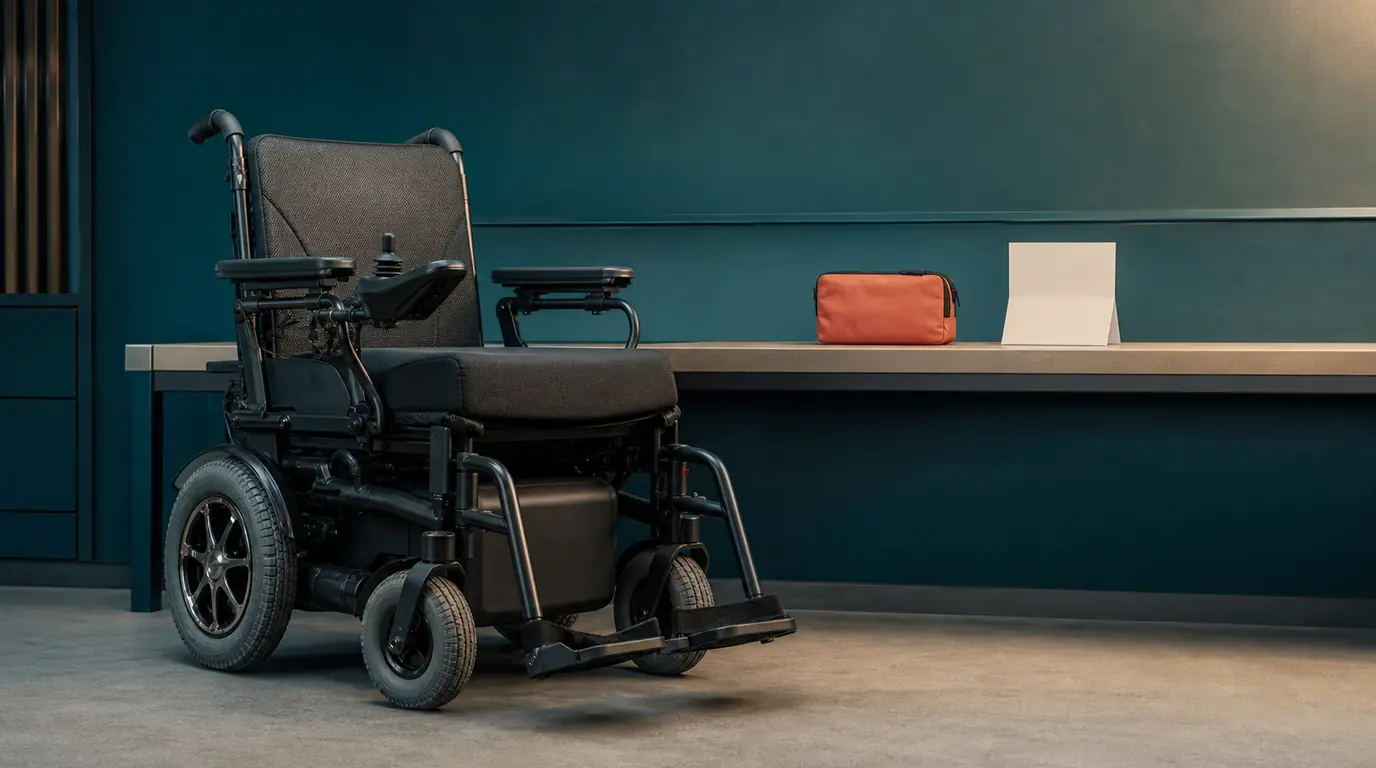
Before handing over a battery-powered wheelchair or mobility scooter, identify the battery chemistry, whether it will stay installed, how the device protects it, and its watt-hour rating if required.
These details determine whether the battery must be removed, how to protect its terminals, how to package it, whether it can travel in the cabin, whether the pilot must be notified, whether the device fits in the cargo hold, and how to coordinate with the airline. FAA, 49 CFR, and DOT guidance was checked on July 31, 2026. Confirm the plan with the operating carrier for every flight segment and connection before departure, as airline procedures can change.
Identify Battery Chemistry
Start with the battery label and the mobility-device manufacturer’s instructions for transport. Do not classify a battery by its color, shape, age, connector, or casual description such as “lithium.” A rechargeable lithium-ion battery follows a different path from a spillable lead-acid battery, a non-spillable gel battery, or a dry sealed battery.
The FAA wheelchair and mobility-device guidance separates these categories because each has different rules for installation, protection, removal, and packaging.
Record the device details
Create a short record that check-in, accessibility, gate, and ramp personnel can read and use. Include:
- Manufacturer, model, and serial number, when available
- Device dimensions and weight
- Battery manufacturer, model, and part number
- Battery chemistry
- Number of installed batteries and spare batteries
- Voltage, amp-hours, and watt-hours for lithium-ion batteries when available
- Whether the battery is installed, removable, or intended to remain installed
- Manufacturer instructions for transport, power isolation, and removal
- A contact for the operating airline and the date of the airline’s instructions
Photograph the battery label and the relevant manufacturer instructions. A clear image can answer questions faster than a verbal description, but it does not replace the airline’s decision or the manufacturer’s documents.
If the battery label gives voltage and amp-hours but not watt-hours, ask the manufacturer or operating airline how to document the rating. Do not rely on an unverified calculation at the airport. The watt-hour value matters most when a lithium-ion battery is removed or carried as a spare.
Keep chemistry categories separate
Lithium-ion batteries are rechargeable lithium batteries commonly used in powered wheelchairs and scooters. The key questions are whether the battery is securely attached, whether the device’s design adequately protects it from damage and short circuit, whether the electrical circuit can be isolated, and whether accidental activation can be prevented.
Non-spillable batteries include qualifying gel-cell and absorbed-electrolyte designs. They have their own conditions for installation, inspection, removal, rigid packaging, markings, and spare batteries.
Dry sealed batteries also have separate requirements. A dry sealed battery that is removed may need strong, rigid packaging and the required “not restricted” marking. Do not assume that a container suitable for a removed lithium-ion battery satisfies the requirements for a dry sealed battery.
Spillable batteries contain liquid electrolyte. Their central carriage issue is whether the device can remain upright during loading, stowage, and unloading. If upright carriage is not possible, the airline may need to remove and package the battery using leak-tight, fluid-resistant packaging, compatible absorbent material, short-circuit protection, and orientation and corrosive markings.
Non-rechargeable lithium-metal batteries are not treated as lithium-ion mobility-aid batteries. FAA guidance forbids them in the mobility-device configurations described there. A battery described only as “lithium” needs further identification before travel.
Stop when information is missing
Pause if the chemistry or watt-hours are unknown, the removal instructions are missing, or the battery housing is unclear. Ask the mobility-device manufacturer for the exact battery type and transport instructions, then provide that information to the operating airline.
Do not dismantle an unfamiliar battery system at the counter. If the battery is uncertain, obtain documentation and instructions before travel instead of choosing the easiest category.
Choose Installed or Removed
For a lithium-ion mobility aid, first decide whether the battery can safely remain installed. “Installed” does not simply mean plugged in. The device and battery must meet the required conditions for protection and preventing activation.
A battery that stays securely attached inside a protective design follows different rules from a battery that must be removed. The current 49 CFR 175.10 passenger exception supplies the controlling U.S. hazardous-material conditions, while FAA PackSafe presents the traveler-facing preparation steps.
Keep a protected lithium battery installed
An installed lithium-ion battery may remain with the mobility device when it is securely attached and adequately protected by the device’s design. The protection must address damage from shifting baggage, mail, service items, and other cargo, as well as short circuits.
If battery cables remain connected, the device must be protected against accidental activation. Electrical circuits must be isolated, and loading and stowage must prevent unintentional operation. The manufacturer may describe this as a transport mode, a power-isolation procedure, a circuit disconnect, or another device-specific step.
Provide the airline with the manufacturer’s instructions showing:
- How the battery is housed or shielded
- How power is isolated
- How the controls are locked or prevented from activating
- Whether freewheel mode should be engaged or disengaged
- Which joystick, controller, cushion, headrest, or other parts detach
- How fragile components should be secured
The traveler must provide accurate information and device instructions. Airline personnel remain responsible for loading, restraint, clearance, and stowage.
Remove lithium only under the required procedure
If the mobility aid does not adequately protect its lithium-ion battery, the battery must follow the removed-battery path. Follow the owner’s or manufacturer’s instructions for removal. Before travel, arrange who will remove the battery if needed and where that work will take place.
A removed lithium-ion battery must be:
- Protected against short circuit, including protection of exposed terminals.
- Protected from physical damage during cabin transport.
- Placed in carry-on baggage only, not checked baggage.
- Reported to the airline, including its location in the cabin.
Terminal protection can include the original retail packaging, insulating exposed terminals with tape, or placing each battery in a separate plastic bag or protective pouch, as applicable. A pouch should also protect the battery from crushing and contact with conductive objects. Follow the manufacturer’s and airline’s instructions rather than assembling an improvised package.
The passenger must tell the airline where the removed battery is located. The operator must then notify the pilot in command of the battery’s cabin location before departure. Keep the battery label and watt-hour information available during check-in and boarding.
Apply the mobility-aid lithium limits
The mobility-aid exception has specific lithium-ion limits. A removed battery must not exceed 300 watt-hours (Wh). A passenger may carry either one spare battery not exceeding 300 Wh or two spare batteries not exceeding 160 Wh each. Removed and spare lithium-ion batteries travel in the cabin under the applicable conditions. These are mobility-aid limits, not the ordinary consumer power-bank limits. A rule learned from a phone charger or laptop battery may not answer the separate question of how a mobility aid’s battery is handled.
The installed-battery path also has conditions for spare batteries. FAA guidance identifies applicable limits for spares, with the spares protected and carried in the cabin. Ask the airline to confirm how it wants the device battery and any spares documented.
Handle other chemistries separately
A qualifying non-spillable or dry sealed battery may remain installed when it is securely attached, protected by the device’s design, protected from short circuit, and protected against accidental activation. The applicable rule also calls for inspection for obvious defects. When removal from the housing is needed for inspection, that work should be performed only by qualified airline personnel.
A removed non-spillable battery generally requires strong, rigid packaging marked “NONSPILLABLE BATTERY,” unless it is fully enclosed in a properly marked rigid housing. A removed dry sealed battery requires strong, rigid packaging with the required “not restricted” marking. No more than one qualifying spare non-spillable or dry sealed battery may be carried per passenger under the applicable conditions.
For a spillable battery, installed carriage depends on upright stowage. The battery must be securely attached, protected by its housing, and protected against short circuit, and the device must remain upright on the aircraft. If the scheduled cargo compartment cannot accommodate the device upright, the airline may need to remove and separately package the battery. That packaging must be leak-tight and impervious to battery fluid, contain enough compatible absorbent material for the battery’s liquid contents if it ruptures, protect against short circuit, keep the battery upright, and carry the required labels.
These distinctions make a generic battery bag or a generic “disconnect the battery” instruction unreliable. The chemistry determines the preparation path.
Prepare Handoff Record
A written handoff record gives different airline teams the same battery information. It should identify what stays with the device, what travels in the cabin, and which tasks require manufacturer instructions or qualified airline personnel.
Write removal instructions
Attach or carry the manufacturer’s removal sequence if the battery can be removed. State who is expected to perform the removal if the airline determines that removal is required. Include the terminal-protection method, the protective pouch or original packaging, and the intended cabin location for the battery.
Do not write a general instruction that tells an untrained person to open the battery compartment, disconnect wires, or dismantle the device. Battery systems may include connectors, locking mechanisms, circuit protection, or components that the manufacturer expects trained personnel to handle.
For non-spillable, dry sealed, and spillable batteries, note that the applicable regulation limits certain inspection or removal work to qualified airline personnel. Bring the instructions and materials the airline requested, but let the airline determine how its personnel will perform the operation.
Protect controls and fragile parts
List detachable joysticks, controllers, cushions, headrests, footrests, armrests, and other removable or fragile components. Describe how the manufacturer says to secure them. If a controller can be disconnected, identify that procedure rather than leaving staff to discover it during loading.
Separate traveler-provided information from ramp operations. The FAA safety notice on battery-powered mobility aids discusses operator concerns such as restraint, clearance, upright positioning, freewheel settings, and power isolation. Those are loading and handling responsibilities for the operator. The traveler’s practical responsibility is to provide accurate dimensions, weight, instructions, and information about vulnerable parts.
Check weight and cargo fit
Ask the operating airline to confirm cargo-compartment fit for the exact aircraft used on each segment. Provide the device’s length, width, height, folded dimensions if relevant, and weight. Include the battery configuration because a device may have different handling dimensions or weight when a battery is removed.
Cargo fit depends on more than whether the device can pass through the cargo door. The FAA safety notice notes that some mobility aids weigh more than 400 pounds and that a 300-pound device can create a concentrated tire load of up to 75 pounds per square inch. Cargo-compartment floor limits, door clearance, restraint points, shoring, center of gravity, and available handling equipment can affect the loading plan.
The traveler is not responsible for ramp engineering. However, accurate measurements and advance confirmation can prevent a dispute at the counter about whether the aircraft can safely carry the device.
Photograph before release
Immediately before handoff, photograph the device’s visible condition, controls, battery area, wheels, frame, and removable components. Record any existing marks or damage in writing. Keep copies of the photographs and the handoff record.
When the device returns, photograph and describe its condition again. A before-and-after record can document what was visible at each point, but photographs alone do not establish the cause of damage, fault, or liability. Use the airline’s reporting process promptly if the device returns damaged or incomplete.
Confirm Every Segment
For an Iliamna itinerary, confirm the battery plan with the operating airline for every flight segment and connection. A codeshare or connecting flight may use a different operator, aircraft, cargo compartment, or handling procedure. The airline that sold the ticket may not be the carrier making the loading decision.
Ask the operating airline
Ask these questions before travel:
- Does the exact wheelchair or scooter fit in the cargo compartment on every segment?
- What dimensions and weight does the airline need?
- What chemistry and watt-hour information must be provided?
- Will the battery remain installed?
- If removal is required, who performs it and where?
- Which manufacturer instructions should accompany the device?
- How should a removed lithium-ion battery be protected and identified?
- Where should the passenger report the battery’s cabin location?
- Can the device and battery details be recorded in the reservation?
- What arrival time and accessibility-team procedure apply?
- Does the airline impose a more restrictive dangerous-goods rule?
The DOT Airline Passengers with Disabilities Bill of Rights states that airlines must accept a battery-powered wheelchair when it fits in the cargo compartment and can be transported consistently with safety and security requirements. DOT also addresses information about aircraft-related and assistive-device storage limitations where feasible. That accommodation protection does not remove the need to establish chemistry, protection, cargo fit, and loading arrangements.
Allow extra time for check-in and handoff. Carry the device record, battery-label photographs, manufacturer instructions, and any terminal-protection materials the airline has asked you to bring. For airport movement, boarding, and arrival assistance, use the separate wheelchair assistance request information. Battery preparation and airport assistance are related but distinct arrangements.
Are medical devices exempt from battery rules?
Medical or disability equipment is not automatically exempt from every battery condition. Disability accommodation and hazardous-material safety requirements both apply.
An airline must address the passenger’s mobility need and accept the device when the applicable fit and safety conditions are met. At the same time, FAA and 49 CFR requirements still govern the actual chemistry, installation, protection, removal, packaging, watt-hours, spare batteries, and notification. A lithium-ion battery that lacks adequate device protection may need to leave the device, travel in the cabin, and be reported for pilot notification.
Confirm both the accessibility arrangement and the battery-handling requirements with the operating airline.
Before You Fly
- Identify the chemistry first: Before anyone handles the device, record whether its battery is lithium-ion, non-spillable, dry sealed, or spillable.
- Verify the installed configuration: For lithium-ion batteries, confirm that the battery is securely attached, protected by the device design, isolated from short circuits, and guarded against accidental activation.
- Prepare removal correctly: If removal is required, follow the owner’s or manufacturer’s instructions, protect terminals and the battery, carry it in the cabin, and tell the airline its cabin location.
- Use the mobility-aid limits: A removed lithium-ion battery must not exceed 300 Wh. The allowance is either one spare not exceeding 300 Wh or two spares not exceeding 160 Wh each, with all other conditions still applying.
- Confirm the aircraft and document condition: Ask the operating airline to verify cargo fit for every segment, then photograph the device before handoff and again at return as a factual condition record.
FAQ
Can I check a power wheelchair with a lithium-ion battery?
Potentially. The battery may remain installed when it is securely attached, adequately protected by the mobility aid’s design, protected from short circuits and cargo movement, and protected against accidental activation. The airline must also be able to accommodate the device’s dimensions and weight safely.
What if the lithium-ion battery must come out?
Removal must follow the owner’s or manufacturer’s instructions. The battery must be protected from short circuit and physical damage, placed in carry-on baggage only, and reported to the airline so the pilot in command can be told where it is located in the cabin. See the 49 CFR passenger exception for the controlling conditions.
Is a removed wheelchair battery subject to a watt-hour limit?
Yes. A removed lithium-ion mobility-aid battery must not exceed 300 Wh. Do not substitute ordinary consumer power-bank limits for the mobility-aid rule.
Can I bring a spare wheelchair battery?
For lithium-ion mobility aids, the allowance is one spare battery not exceeding 300 Wh or two spares not exceeding 160 Wh each. The spares must travel in the cabin under the applicable conditions. Qualifying non-spillable or dry sealed batteries generally have a one-spare limit with separate packaging and marking requirements.
Do I need to tell the airline where my removed battery is?
Yes. The passenger must advise the airline of the cabin location of a removed lithium-ion battery. The operator must notify the pilot in command before departure.
Can I handle battery removal at the airport?
Do not improvise. Lithium-ion removal must follow the owner’s or manufacturer’s instructions. For non-spillable, dry sealed, and spillable batteries, removal from the housing for required inspection should be performed only by qualified airline personnel under the applicable conditions.
What if I do not know the chemistry or watt-hour rating?
Pause the handoff. Get the device and battery documents from the manufacturer, then give the operating airline the exact model and battery details. Do not classify the battery from its appearance or assume that a label saying only “lithium” means lithium-ion.
Can I fly with a spillable wheelchair battery?
Possibly. A spillable battery may remain installed when it is securely attached, protected against short circuits, and the device can remain upright during loading, stowage, and unloading. If upright carriage is not possible, the airline may need to remove and package the battery under the applicable leak-tight packaging, absorbent-material, protection, and marking requirements. Confirm the plan with the operating airline before travel.
Does this cover ordinary power banks?
No. A mobility-aid battery follows a dedicated exception with distinct watt-hour, carry-on, notification, and handling conditions. For ordinary portable chargers and consumer spare batteries, consult the separate power-bank rules for planes. For broader packing planning, use the baggage planning collection.