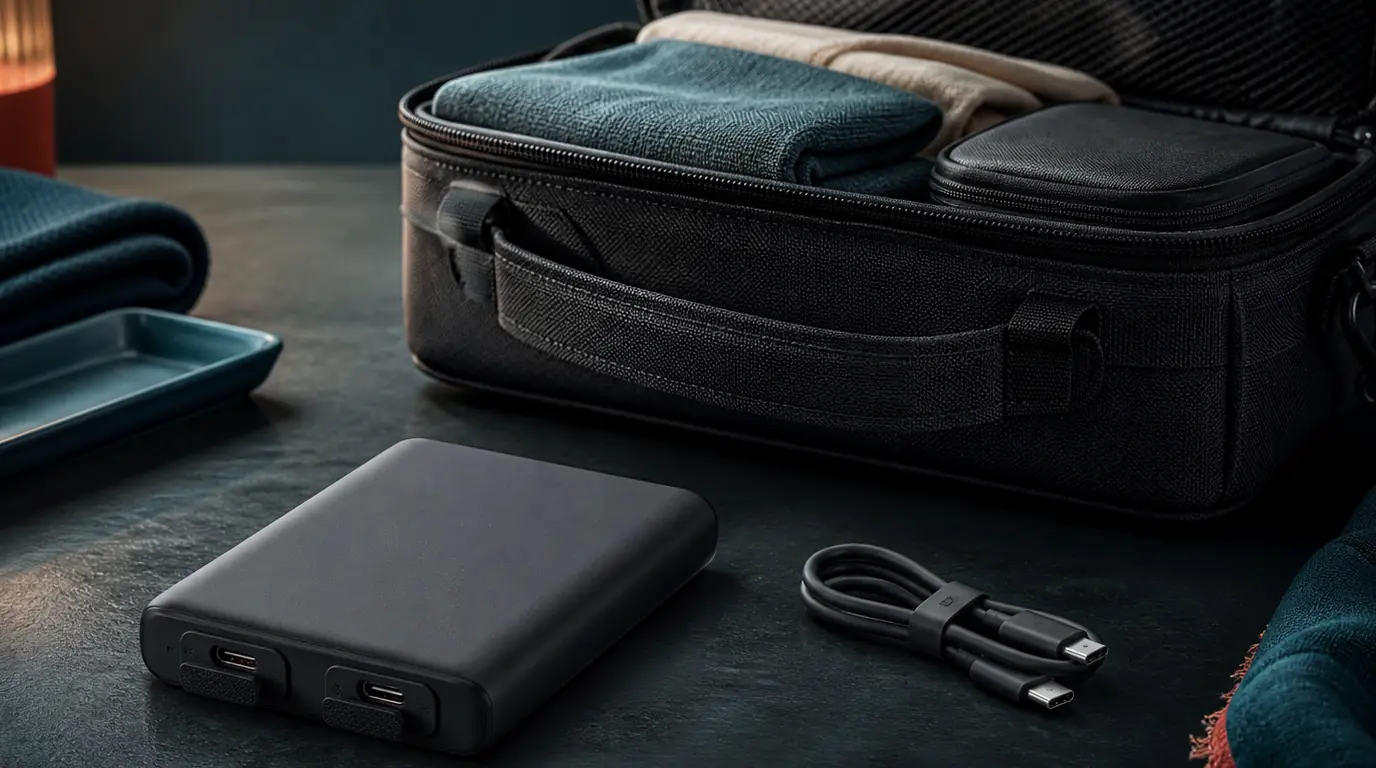
A power bank is a separate rechargeable battery that charges another device. For passenger baggage, the Federal Aviation Administration (FAA) treats it as a spare lithium battery, not as a battery installed in a phone, laptop, or tablet.
This distinction determines where you pack the power bank and what you must check before departure. Under the United States FAA baseline, power banks belong in the cabin, not in checked baggage. You also need a verified watt-hour rating, protection from damage and short circuits, and a plan for a gate check of your carry-on. Airlines, security authorities, crew members, and international rules may be stricter. For related packing guides, return to the Baggage hub.
Identify the Battery and Its Rating
Identify the item before judging its size. A portable charger, external battery, charging bank, or power bank usually contains a battery that is not installed in the device it charges. FAA guidance groups portable rechargers and external battery chargers with spare lithium-ion batteries. A phone or laptop with its battery installed follows separate rules under the FAA’s PackSafe lithium-battery guidance.
Packing a power bank beside the phone it charges does not change its status. The phone has an installed battery. The power bank remains a spare battery because it can be carried separately.
Next, find the watt-hour rating, shown as Wh. Check the power bank label, packaging, or manufacturer technical documentation, and record the value exactly as printed. Do not estimate a missing rating from the product’s size, weight, price, number of ports, charging speed, or marketing claims.
Battery chemistry also matters, but do not infer it from appearance or branding. Many power banks use lithium-ion or lithium-polymer cells, but a USB connector or product shape does not show what is inside. Use the manufacturer’s labeling and documentation.
Calculate Watt-Hours
If the manufacturer does not print Wh but gives both the battery voltage and capacity, use this calculation:
Wh = volts (V) × amp-hours (Ah)
For capacity in milliamp-hours:
Wh = volts (V) × milliamp-hours (mAh) ÷ 1,000
For example, manufacturer specifications showing 3.7 V and 20,000 mAh produce:
3.7 × 20,000 ÷ 1,000 = 74 Wh
This calculation works only when both values come from verified manufacturer specifications. A mAh figure alone is not enough. You also need the voltage to measure energy in watt-hours.
Do not use the USB output voltage as the battery voltage. A power bank may advertise 5 V, 9 V, or 20 V output even though its internal battery uses a different voltage. The FAA provides the same watt-hour conversion method, but calculating Wh does not approve a device for a particular flight.
Stop Without Verified Data
If the power bank has no Wh label and the manufacturer does not provide verified voltage and capacity, stop the assessment. Do not assign a watt-hour value based on its appearance, advertised output, or the typical voltage of similar products.
A label that states only “20,000 mAh” leaves one required value unverified. Output power without the battery voltage and capacity also does not establish Wh. Look for manufacturer documentation or ask the operating airline. Do not guess.
Apply the Watt-Hour Limits
The FAA passenger-battery chart provides a United States baseline for rechargeable batteries:
| Battery rating | United States FAA baseline |
|---|---|
| Up to and including 100 Wh | Generally within the ordinary passenger limit, subject to cabin-only carriage and airline rules |
| 101 through 160 Wh | Up to two larger power banks may be carried with airline approval, subject to current carrier rules |
| Above 160 Wh | Not permitted for ordinary passenger carriage |
The chart covers battery size, not where to pack the battery. A power bank within a permitted size band is still a spare battery and must stay with the passenger in the cabin under the FAA baseline.
Use the product’s own verified specifications. A seller calling an item “airline friendly,” or a similar-looking product with a known rating, does not establish this power bank’s rating.
Check Mid-Range Power Banks Directly
Check the mid-range directly, especially for power banks. The current FAA chart allows up to two larger power banks from 101 through 160 Wh with airline approval. That United States approval path does not bind an airline under a stricter policy or override international rules.
Published 2026 international passenger guidance is stricter. IATA guidance for passengers lists power banks over 100 Wh and up to 160 Wh as forbidden. It distinguishes them from certain other spare batteries that may have an operator-approval route. The International Civil Aviation Organization’s updated specifications also limit passengers to two power banks and prohibit recharging them during flight.
Do not treat the FAA approval band as universal permission for a mid-range power bank. Ask every operating airline about the exact device, route, quantity, and approval requirements.
Under 100 Wh Is Not Automatic
A verified rating below 100 Wh fits the ordinary FAA size threshold, but it does not confirm that the label is accurate or show that the battery is safe. It does not override a recall, make a swollen or damaged battery suitable for travel, guarantee security-screening acceptance, or bind the operating airline.
Airlines may set stricter watt-hour or quantity limits. International rules may limit the number of power banks or prohibit in-flight charging. A sub-100 Wh rating answers only one part of the assessment; you still need to check condition, cabin placement, terminal protection, airline policy, and jurisdiction rules.
Pack It in the Cabin
The FAA says spare lithium batteries, portable rechargers, and power banks are prohibited in checked baggage. Keep the power bank in carry-on baggage and with you in the passenger cabin. The FAA’s baggage summary explains the checked-baggage prohibition and what to do if a carry-on is taken for loading.
Keeping the power bank in the cabin does not remove physical risks. A loose power bank can be crushed, switched on by accident, or short-circuited by metal objects.
Protect Terminals and Controls
Use the original retail packaging, a battery case, or a snug protective pouch. Keep the power bank away from coins, keys, tools, and other conductive metal objects. If the terminals are exposed, use an appropriate way to prevent contact, such as terminal insulation where applicable.
Protection should prevent:
- Damage: Keep the battery from being bent, punctured, crushed, or struck.
- Short circuits: Keep exposed contacts away from metal objects.
- Accidental activation: Do not place it where pressure can turn it on or cause heating.
Keep it accessible for screening or a gate check. If the Wh value is available only in manufacturer documentation, save that information before leaving home. Documentation may help explain the specification, but it does not replace a required label in every circumstance.
Handle Gate Checks
A carry-on can become checked baggage at the gate or planeside. Before you hand it over, remove the power bank and every other spare lithium battery. Keep them with you in the cabin.
The FAA specifically says power banks must be removed during a gate or planeside check. Store the power bank in a small accessible pouch rather than deep inside a tightly packed bag. Once the bag goes into the aircraft hold, a power bank inside it is in the wrong place under the FAA baseline.
Do Not Pack Unsafe Batteries
Do not pack a power bank that is swollen, unusually hot, leaking, cracked, smoking, physically damaged, defective, or subject to a recall. A battery that still charges a phone may still be unsafe to transport.
The FAA excludes damaged or recalled batteries likely to spark or generate dangerous heat unless handled under the applicable safety rule. Do not rely on home repairs, improvised insulation, or different packaging to make a damaged device travel-ready. Check the manufacturer, seller, and applicable recall resources for instructions on the specific product.
Check Smart Luggage Separately
A suitcase with an integrated charging bank, tracker, electronic scale, or motor has separate baggage rules. Do not apply the ordinary installed-battery rule to every battery feature in a suitcase.
The FAA’s smart-baggage guidance distinguishes removable and non-removable batteries. Smart baggage generally must travel in the cabin unless its battery is removed. If removable, take the battery out before checking the suitcase and treat it as a spare battery in cabin baggage. Airlines may impose additional smart-bag restrictions, particularly on international flights.
Recheck Every Flight
Use FAA guidance as a United States reference point, not as universal approval. The FAA PackSafe page warns that airlines and international requirements can be stricter. The operating airline, security authority, crew instructions, and applicable law make the final decision.
Before departure, check the dangerous-goods or lithium-battery policy for every operating carrier. Confirm:
- Maximum permitted Wh rating for a power bank
- Allowed number of power banks
- Whether approval is required
- Whether power banks over 100 Wh are prohibited
- Required cabin storage location
- Whether in-flight charging is prohibited
- Gate-check procedures
International and multi-airline trips need extra attention. The departure, transit, or destination country may have different requirements, and one carrier may be stricter than another. Before the flight, verify the Wh value, check for damage or recalls, protect the battery in carry-on baggage, and review each operating airline’s current policy. If any step fails, do not decide eligibility from appearance or a generic online listing.
Packing Checklist
- Verify watt-hours: Use the manufacturer’s labeled Wh value, or calculate Wh only from verified voltage and capacity. Do not estimate a missing rating.
- Keep power banks in the cabin: Under the FAA United States baseline, power banks and other spare batteries cannot go in checked baggage.
- Protect the battery: Use packaging, a case, or a pouch, and prevent metal contact, crushing, and accidental activation.
- Remove it for a gate check: Take power banks and all spare lithium batteries out before a carry-on goes to the hold.
- Recheck the itinerary: Airline and international limits may be stricter, including quantity limits, restrictions above 100 Wh, and in-flight charging bans.
FAQ
Can I put a power bank in checked baggage?
No, not under FAA United States passenger guidance. Spare lithium batteries, portable rechargers, and power banks must remain with the passenger in carry-on baggage.
Is 20,000 mAh enough information?
No. You also need the manufacturer’s battery voltage to calculate watt-hours accurately. Use V × mAh ÷ 1,000 only when both values are verified. Do not substitute USB output voltage or an assumed battery voltage.
Can I bring a mid-range power bank if the airline approves it?
Do not presume approval is available or sufficient. The FAA chart includes an airline-approval path for up to two power banks from 101 through 160 Wh, while published 2026 IATA passenger guidance lists power banks over 100 Wh as forbidden. Ask the operating airline about the specific power bank and itinerary.
What should I do if my carry-on is checked at the gate?
Remove the power bank and all spare lithium batteries before handing over the bag. Keep them with you in the passenger cabin.
Can a power bank stay inside smart luggage?
Do not assume it can. A removable battery generally must be removed before the suitcase is checked and then treated as a spare battery. Check the operating airline’s smart-bag policy before travel.
Can I pack a recalled or swollen power bank if it still works?
No. Do not pack a swollen, overheated, leaking, damaged, defective, or recalled power bank. Contact the manufacturer, seller, and applicable recall authorities for product-specific instructions.