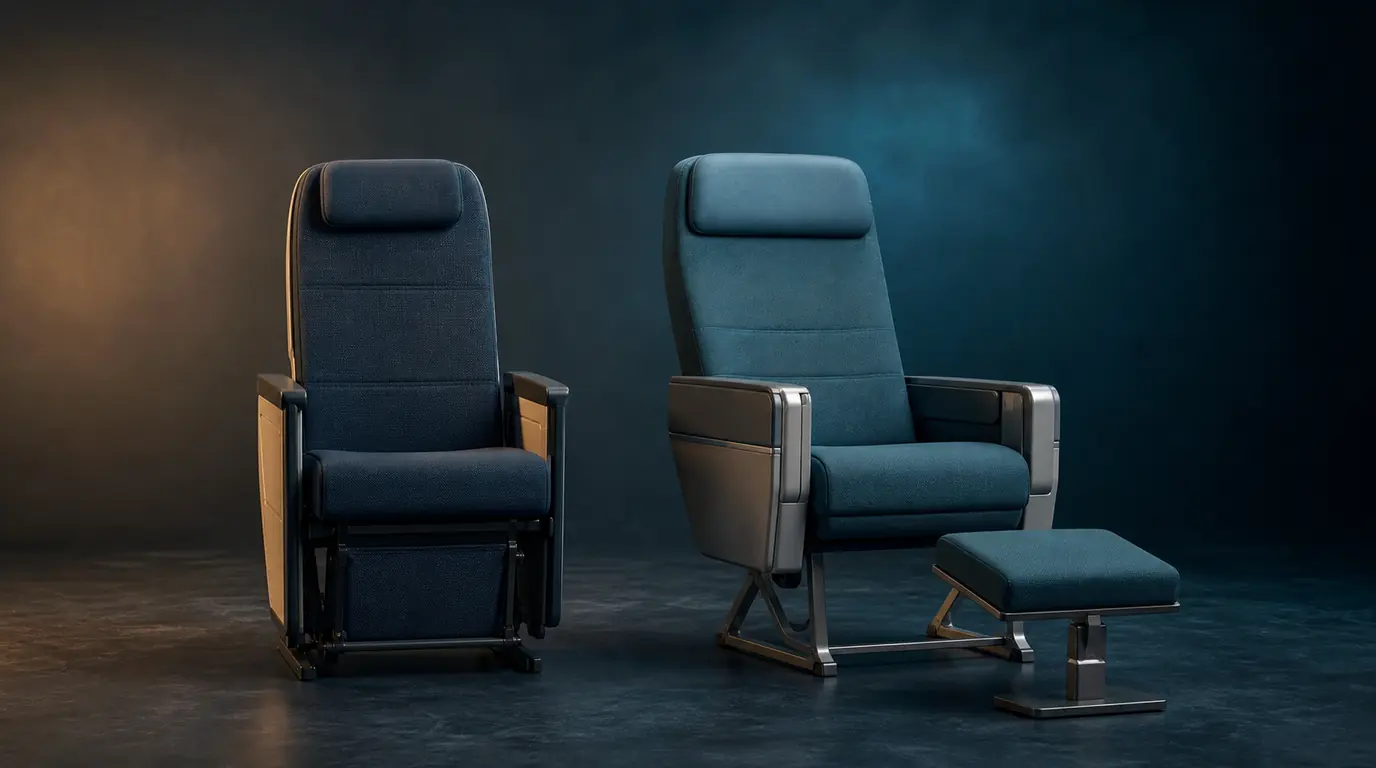
Premium economy varies widely by airline. It may offer extra legroom, a wider seat, priority boarding, different meals, or only slightly more seat pitch. The label signals a product positioned above economy and below business, but it is not a product specification. It does not tell you which airline operates the flight, the aircraft layout on your travel day, the seat you will get, what the fare includes, the baggage rules, or what happens if the itinerary changes.
This matters because travelers often pay more for the cabin name before checking what the trip actually includes. A premium-economy ticket improves the trip only when its details show a real, verifiable difference that matches the traveler’s priorities. Upgrade decisions go wrong when travelers treat the label as a promise instead of checking seven separate facts.
Identify the Operating Carrier
Before comparing cabins, fares, or seats, the traveler needs to know which airline will fly the aircraft. This may seem obvious, but the airline named on the itinerary often is not the airline operating the flight. Under U.S. rules, a code-share arrangement exists when one carrier’s designator code identifies a flight operated by another carrier. The operating carrier is the carrier that runs the aircraft, regardless of whose name or flight number appears on the ticket.
Consider a fictional example: a traveler books a flight marketed by “Aurora Air” showing a premium-economy fare, but the aircraft is actually operated by a regional partner, “Boreal Airways,” under a code-share agreement. If Boreal’s premium-economy cabin uses a different seat pitch, different boarding process, or different meal service than Aurora’s own aircraft, the traveler’s expectations built around Aurora’s brand may not match the trip they actually take. Nothing about the fictional example above should be read as describing a real premium-economy product; it illustrates why the operating carrier has to be confirmed before any other record makes sense.
Code-Share Disclosure Rules
U.S. rules do not leave this identification to chance. They require the transporting carrier’s identity to be disclosed in specified schedule, itinerary, oral-sales, and written confirmation contexts. In practice, that means a traveler shopping or booking a covered code-share flight should expect to see an “operated by” notice, or equivalent wording, identifying the carrier that will actually fly the aircraft.
The check is simple: read the confirmation email and the airline’s booking record, not just the marketing name in a search result. If a segment says “operated by” a different airline, use that operating carrier as the source for everything that follows: aircraft type, cabin layout, seat assignment, and service policy. If multiple segments on one itinerary are operated by different carriers, each segment needs its own check, because a premium-economy cabin on one leg may not resemble the premium-economy cabin on the next.
Confirm the Aircraft and Seat
After confirming the operating carrier, check the aircraft. A cabin name does not identify one aircraft type or one cabin layout. The same airline can fly several different aircraft types on similar routes, and the same aircraft type can be configured differently across an airline’s fleet, particularly after retrofits or fleet mergers. A premium-economy cabin advertised on one aircraft type might have a materially different seat width, pitch, or in-seat power setup than the premium-economy cabin on another aircraft the same airline flies on a similar route.
Aircraft and Cabin Layout
Check the aircraft and its configuration for the specific flight. Do not assume them from the cabin name. Airlines typically list the expected aircraft type on the booking confirmation or the “flight details” view of an itinerary, though that listing can still change before departure due to operational substitutions. Because none of this can be verified through a static guide, the practical step is to check the airline’s own confirmation close to departure and again at check-in, rather than relying on whatever aircraft was listed when the ticket was purchased.
Seat Assignment and Exit Rows
Buying access to a premium-economy cabin does not mean you have a specific seat. Some fares include a seat assignment at booking; others assign seats later, sometimes at check-in, sometimes at the gate. A traveler who wants a particular seat location within the premium-economy cabin, such as a bulkhead row or a specific aisle, needs to confirm the actual assignment, not just the cabin purchase.
Exit-row seats deserve separate treatment, because they carry a safety function that has nothing to do with comfort. Exit seating is subject to specific federal aviation rules covering safety-related seating suitability, passenger function, instruction, and reseating procedures. FAA passenger guidance is direct about what that means in practice: an occupant of an exit row must be physically capable and willing to perform emergency actions, and a passenger who cannot or does not want to take on that role should ask for a different seat. The same guidance recommends that every passenger, not just those in exit rows, locate the exits ahead of and behind their seat and count the rows to each one as part of normal flight preparation. An exit row inside a premium-economy cabin should never be treated as simply an extra-legroom upgrade; it is a seat with a defined responsibility attached.
Check Fare and Baggage Records
A cabin name does not clearly tell you what the price includes. Airlines routinely sell the same nominal cabin under fares that differ in what they include, and they separately sell services that have nothing to do with the cabin at all. Two travelers in the same premium-economy row on the same flight can be carrying very different entitlements, because they bought different fare types.
Fare Inclusions and Optional Services
U.S. rules define optional services as airline services offered for a fee beyond basic passenger transportation, and the regulation names concrete examples: advance seat selection and seat upgrades, along with items like checked and carry-on baggage, in-flight food and drink, and comfort items such as pillows or blankets. That list is useful precisely because it shows how many things a cabin name might seem to imply, without actually guaranteeing any of them.
Read the fare rules for the specific ticket, not the cabin’s general reputation. If the itinerary involves a code-share, there is an added layer: for covered code-share travel, the marketing carrier is required to disclose differences between its own optional services and fees and those of the operating carrier. That disclosure requirement exists because the marketing carrier’s usual premium-economy inclusions do not automatically transfer to a flight actually operated by a partner airline with its own fee schedule.
Baggage and Packing Rules
Baggage raises two separate questions that are easy to mix up. The first is what the fare includes: a premium-economy fare may carry a different checked-bag allowance than an economy fare on the same flight, or it may not. For air transportation within, to, or from the United States, e-ticket confirmations are required to state the passenger’s free baggage allowance and applicable carry-on, first checked bag, and second checked bag fees. That allowance is a fare record, tied to the specific ticket and itinerary, not a fact that can be assumed from the cabin name alone. Iliamna’s baggage-allowance guide separates the item, limit, journey, passenger context, and fee status.
The second question is what can be packed at all, and that is governed by an entirely different rule set. The FAA’s PackSafe guidance draws a clear line between dangerous-goods safety rules and TSA security screening, which are separate frameworks even though they can overlap on the same item. That same guidance warns that individual carriers and international requirements can be more restrictive than domestic defaults, so a rule that applies on a short domestic hop may not apply on a connecting international segment. A premium-economy traveler packing a spare battery, a sporting item, or a duty-free liquid purchase needs to check both the fare’s baggage allowance and the applicable packing restrictions, since a wider seat does not change either one.
Accessibility Needs and Itinerary Changes
A seating-related disability need is different from ordinary seat selection. It follows a separate process with its own rules, distinct from paying for a preferred seat.
Disability Seating Accommodations
U.S. rules require carriers to provide specified seating accommodations when a passenger identifies a qualifying need and the accommodation exists on that particular aircraft. That “exists on that aircraft” qualifier matters: an accommodation available on one aircraft type in an airline’s fleet is not guaranteed on every aircraft the airline flies, which loops back to the earlier aircraft-and-layout check.
A related rule clarifies the limits of that accommodation. Carriers may not exclude a passenger with a disability from a seat or require a particular seat on the basis of disability except to meet FAA or applicable foreign-government safety requirements, and the required accommodation does not require the carrier to furnish more than one seat per ticket or a seat in a class of service other than the one purchased. A carrier may choose to provide more, but the rule does not turn an accommodation request into a free premium-economy or business upgrade. Anyone with a seating-related need should contact the operating carrier directly and treat this as a distinct process, not as a variable to weigh against a premium-economy purchase.
Rechecking After an Itinerary Change
A schedule change, aircraft swap, or cancellation rebooking can change every record you already checked. A new operating carrier, a different aircraft, a different cabin layout, and a different fare rule set can all follow from a single itinerary change, even if the airline’s app still shows the same cabin name.
Redo the checks from the start after any itinerary change because the original premium-economy details may no longer apply. Reconfirm who is operating the new flight, what aircraft is listed, what seat is assigned, what the fare rules now say, what the baggage terms are, and, if relevant, whether the accommodation request remains recorded for the changed flight. The rebooked ticket’s cabin label alone cannot confirm that these details stayed the same.
When the Upgrade Actually Matters
This is not an argument against premium economy. It is an argument against deciding from the name alone. A premium-economy fare changes the trip when a specific, checked record shows a real difference that matters to that traveler, on that itinerary.
Paying more has a confirmed basis only when the traveler’s actual flight records show a relevant difference. Check the fare rules for any baggage difference, the operating carrier’s current aircraft and seat information for a physical difference, and the marketing carrier’s code-share fee disclosure for any optional-service differences from the operator. Records showing no confirmed seat, service, or baggage advantage leave the cabin name without a documented reason to justify the extra cost. The decision depends on what a specific fare, aircraft, and operating carrier are currently scheduled to deliver, rather than on the reputation of “premium economy” as a category.
How Much Checking Is Necessary
Checking seven records may seem excessive for a simple upgrade decision, especially on a familiar route with a familiar airline. On many bookings, several of these checks will confirm exactly what the traveler expected, and that is a legitimate outcome. The goal is not to find a problem on every trip.
The need for separate verification is clearest where the marketing name and the operating reality diverge. U.S. rules require disclosure of the transporting carrier in covered code-share displays and confirmations, and the current fee rule requires the marketing carrier’s website to disclose differences between its optional services and fees and those of the operating carrier. A straightforward flight marketed and operated by one airline may need only a quick confirmation. A code-share, mixed-carrier itinerary, aircraft change, or disability-related seating request deserves a fuller check. The practical position is moderate: do not turn a cabin label into a promise, but also do not assume every check will surface a problem. Verify the records that are relevant to the specific trip, starting with who is actually operating the aircraft.
Key Takeaways
- Verify the operating carrier before anything else: A marketing airline’s name can differ from the carrier actually flying the aircraft under a code-share arrangement, and U.S. rules require that operator to be disclosed on the itinerary and confirmation.
- Separate the cabin purchase from the seat assignment: The purchase secures a class of service without automatically securing a specific row. Exit-row seats carry emergency responsibilities, and FAA guidance says occupying them requires both capability and willingness.
- Treat fare inclusions, baggage, and packing rules as three different checks: Optional services like seat selection and upgrades, baggage allowances, and dangerous-goods or security restrictions each follow their own rules, and none of them can be assumed from the cabin name.
- Route disability seating needs through the carrier’s accommodation process: U.S. rules provide specific seating accommodations tied to what exists on the aircraft, but they do not convert into a free upgrade to a different class of service.
- Redo every check after an itinerary change: A new aircraft, operating carrier, or fare rule can follow a schedule change even when the cabin label on the ticket stays the same.
What Premium Economy Really Changes
Premium economy is a real product category, but its name alone does not answer whether it is worth buying. What decides whether the upgrade changes the trip is what shows up in seven checkable records: the operating carrier, the aircraft and layout, the seat, the fare and its optional services, baggage terms, any accessibility need, and the state of those records after a change. Checking them does not reduce the value of a premium-economy fare when its benefits are real. It keeps a marketing label from replacing a confirmed fact. The same record-by-record method appears in Iliamna’s economy-seat comparison.
For a side-by-side decision, put those records into Iliamna’s private flight-comparison sheet. It performs no lookup and stores nothing; it simply keeps verified differences and unknowns visible.
FAQ
Does operated by matter for a premium-economy decision?
Yes. In a code-share arrangement the airline named in the marketing may not be the airline flying the aircraft, and U.S. rules require the operating carrier’s identity to be disclosed in specified itinerary and confirmation contexts. Check that disclosure before drawing any conclusion about the cabin, seat, or service on that flight.
Does buying premium economy guarantee a specific seat?
No. Cabin access and seat assignment are separate facts, and a traveler should confirm the actual assigned seat rather than assuming the cabin name guarantees a particular aisle, window, bulkhead, or exit-row position. Some fares assign seats at booking, while others assign them later.
Are seat selection and upgrades always included in the fare?
Not necessarily. U.S. rules specifically list advance seat selection and seat upgrades as examples of optional services that can be charged separately from the base fare, alongside baggage and certain onboard items. Read the specific fare rules attached to the ticket rather than assuming inclusion.
If I have a disability-related seating need, does premium economy solve it?
Not automatically. Seating accommodations under U.S. rules are handled through a separate process tied to what the carrier can provide on that particular aircraft, and the accommodation does not entitle a passenger to a class of service other than the one purchased. Contact the operating carrier directly to start that process rather than treating it as a retail seat-selection decision.
Is an exit-row seat always the best choice in premium economy?
No. Exit-row seating comes with a defined emergency role, and FAA guidance states that the occupant must be physically capable and willing to perform emergency actions. A passenger who is not able or willing to take on that responsibility should request a different seat, regardless of the extra space on offer.
What if my premium-economy flight gets rescheduled onto a different aircraft?
Recheck the departure time, cabin layout, operating carrier, fare terms, and baggage terms because the replacement aircraft or code-share carrier may differ, and the original booking terms may no longer match the new flight.