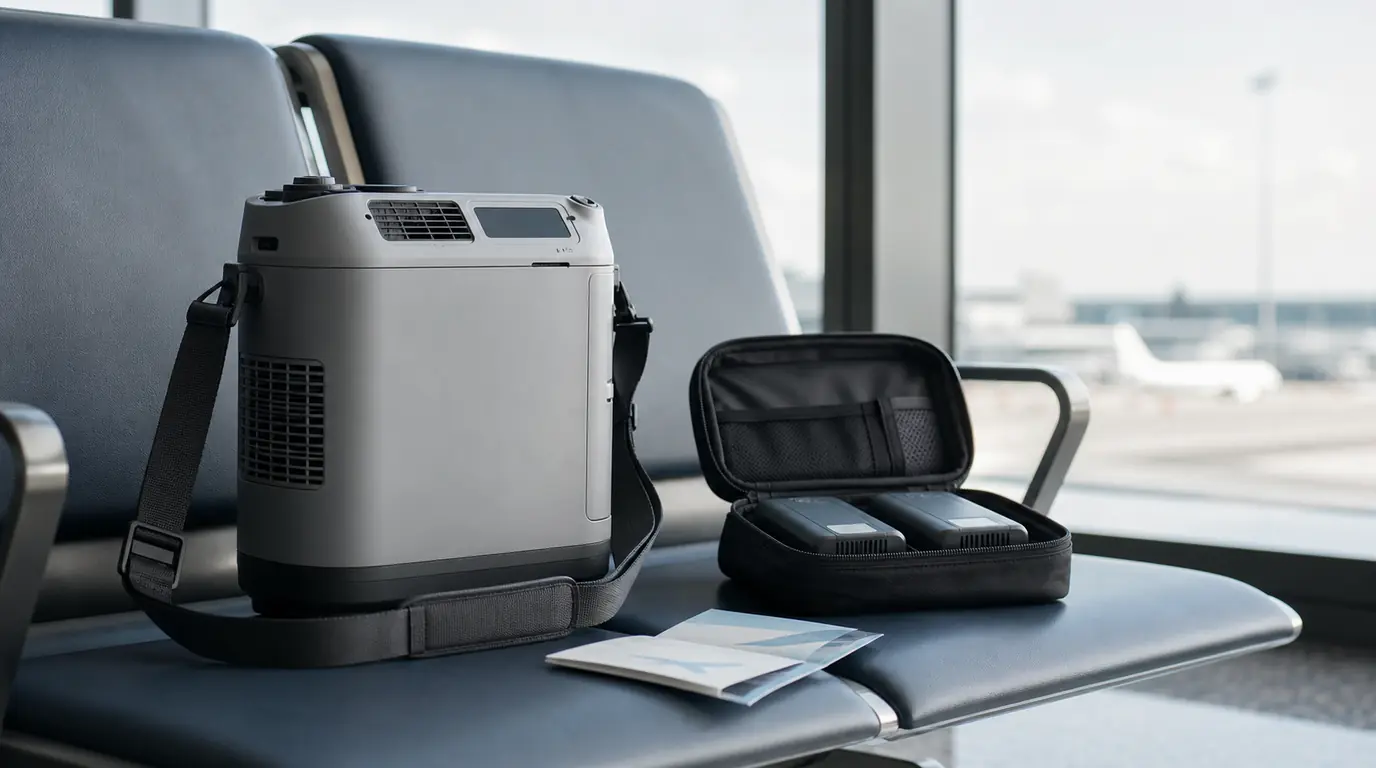
Flying with a portable oxygen concentrator (POC) takes more than bringing it to the airport. The exact device must meet Federal Aviation Administration (FAA) acceptance requirements. Its batteries must be allowed and last for the planned travel time. Each operating airline must also confirm its procedures.
Common problems include a device that cannot be verified, spare batteries in checked baggage, an unconfirmed partner flight, or no oxygen plan for a layover or after landing. U.S. Federal Aviation Administration and Centers for Disease Control and Prevention guidance was checked July 31, 2026. A clinician must determine medical fitness and oxygen settings. The operating airlines must determine device acceptance.
Match the Device to FAA Rules
Verify the exact manufacturer and model rather than relying on a retailer’s description such as “portable oxygen machine.” FAA acceptance depends on the applicable technical criteria, conformity-label path, or retained accepted-model rule. A product category alone does not show that a particular device may be used onboard.
The FAA’s acceptance criteria for portable oxygen concentrators include requirements such as lawful U.S. marketing under Food and Drug Administration rules, no harmful radio-frequency interference with aircraft systems, no generation of compressed gas, and no prohibited hazardous materials other than permitted battery provisions. Qualifying newer devices generally need the specified manufacturer conformity label. Some previously accepted models may still qualify under a legacy regulatory route.
Separate Oxygen Categories
A POC takes in surrounding air and concentrates oxygen for delivery. It does not store oxygen in a pressurized cylinder or liquid-oxygen container. That difference puts it under separate FAA and baggage rules.
Compressed oxygen is stored as gas under pressure. Liquid oxygen uses a different container and handling system. Neither item becomes a POC because it is portable, battery-connected, or marketed for personal use.
Read the FAA’s PackSafe guidance for POCs and its separate page on compressed or liquid oxygen as separate rules. In the United States, passengers may not carry their own compressed or liquid oxygen in carry-on baggage, checked baggage, or on their person. A passenger-supplied cylinder is not an alternative version of a POC.
Airline-provided oxygen is a separate category. A carrier may offer it as a service, but airlines are not required to provide onboard oxygen, and many do not. Ask the operating airline directly rather than assuming an airline-supplied system will be available.
Check the Exact Model
Before asking the airline for confirmation, collect the information that identifies the device and explains its acceptance:
- Device identity: Manufacturer name
- Exact model name and model number
- Photograph or transcription of the FAA conformity label, if the device has one
- Serial number, if requested by the airline
- User manual or manufacturer specification sheet
- Battery details: Exact battery model numbers
- Battery chemistry and watt-hour markings
- Condition: Evidence that the device and batteries are undamaged and in usable condition
A similar model name does not prove that the device qualifies. A retailer may group several versions under one product family, and an older online discussion may describe a rule or model status that no longer applies. The key question is whether the exact device follows the FAA acceptance criteria or an applicable legacy-model route.
Keep the device label and manual easy to reach during travel. If a gate agent or security officer asks what the equipment is, the traveler or companion should be able to identify the model without relying on memory.
Confirm Every Operating Airline
FAA device acceptance and airline procedures address different questions. FAA rules concern whether the device fits the applicable aircraft-use criteria. The airline sets its process for notice, documentation, seating, stowage, battery information, and itinerary changes.
For a connecting trip, identify the carrier listed as “operated by” on every segment. The company that sold the ticket or appears first in the booking may not operate every flight. Include regional, partner, charter, and international legs when they appear in the itinerary.
The CDC Yellow Book guidance on air travel advises travelers who need in-flight supplemental oxygen to notify the airline at least 72 hours before departure. That timing helps with planning but does not replace the operating carrier’s current process. Contact each carrier as early as possible because a form, review, or battery approval may take additional time.
Build a Segment Record
Use one record for each flight, not one confirmation for the entire booking.
| Segment | Operating airline | Flight and date | Exact device confirmed | Notice deadline | Battery instructions | Documents requested | Contact and reference |
|---|---|---|---|---|---|---|---|
| Departure leg | |||||||
| Connection leg | |||||||
| Return leg |
Ask the airline to address the exact POC manufacturer and model. Record the date, contact method, representative or department if available, and any reference number. If the carrier provides instructions by phone, write down the wording and ask whether written confirmation is available.
A confirmation from one carrier does not automatically cover another carrier. A confirmation for one flight may not explain what happens after an aircraft swap, missed connection, or rebooking to a partner airline.
Ask the Airline Directly
Give the airline the device and battery details instead of asking only whether it accepts “oxygen equipment.” Questions should cover:
- Device and flight: Can this exact POC model be used on the listed flight?
- Advance notice: What process and deadline apply?
- Documentation: Does the airline request a clinician statement, medical form, or other documentation?
- Batteries: What quantity, watt-hour information, or approval does the carrier require?
- Spare batteries: How must they be packed and presented?
- Airport handling: What boarding, security, and gate procedures apply?
- Stowage: How must the POC be stowed during taxi, takeoff, and landing?
- Seating: Are there restrictions or seat-assignment requirements?
- Aircraft power: May the traveler use an aircraft electrical outlet with this device on this flight?
- What happens if the aircraft, operating airline, or connection changes?
Do not depend on a seat outlet unless the airline has confirmed that power will be available and allowed for the exact flight and device. An outlet may be unavailable, inoperative, incompatible, or restricted during part of the journey.
FAA Acceptance Does Not Confirm Airline Procedures
FAA acceptance does not settle airline procedures or manage the itinerary. The traveler still needs to identify every operating carrier, meet notice requirements, confirm battery handling, answer documentation questions, and preserve a plan for delays and ground travel.
This distinction explains why general restrictions on passenger-supplied oxygen do not apply to POCs. The prohibition concerns passenger-supplied compressed or liquid oxygen. A POC concentrates oxygen from ambient air and follows a separate acceptance route.
Build the Battery and Oxygen Plan
Battery planning has two steps. First, determine how long the traveler may need the POC. Second, check whether each battery may be carried and whether the airline has stricter limits.
The FAA says a traveler relying on a POC should carry sufficient spare batteries in carry-on baggage for the duration of the flight. Spares must be protected against damage and short circuit. That requirement concerns safe carriage and operational readiness. It does not determine a traveler’s clinical oxygen needs.
Estimate Reliance Time
Use the traveler’s established clinical travel plan, the exact device’s manufacturer runtime information, the itinerary, and time outside the aircraft. Include:
- Travel from home to the departure airport
- Check-in, security, and boarding
- The scheduled flight
- Taxiing and possible airport delays
- Connection time
- Missed-connection or overnight risk
- Arrival, baggage collection, and ground transportation
- The period before ground oxygen is available
- A disruption allowance chosen for the individual plan
A worksheet can organize the inventory:
[ \text{Battery units to carry} = \left\lceil \frac{\text{planned POC reliance time + disruption allowance}} {\text{verified runtime per exact battery}} \right\rceil ]
This calculation only estimates inventory. It does not recommend an oxygen flow or medical setting, and it does not guarantee that a specific battery count will meet an individual’s needs. Runtime can change with the device configuration, battery condition, temperature, use pattern, and other factors. The clinician should address the established medical plan, while the manufacturer supplies device-specific runtime information.
The FAA POC guidance does not set one universal multiplier or fixed number of spare batteries for every traveler. Build the count from the actual reliance period and then check it against the airline’s rules.
Apply Battery Carriage Rules
For rechargeable lithium batteries generally, the FAA’s passenger battery guidance uses these watt-hour categories:
- Not more than 100 Wh: Allowed on passenger aircraft under the FAA baseline when the applicable packing and condition rules are met.
- 101 through 160 Wh: Requires airline approval. The FAA baseline permits no more than two spare lithium-ion batteries per person in this range.
- More than 160 Wh: Prohibited on passenger aircraft under the general rule.
These thresholds are a dangerous-goods screening baseline, not a personal battery recommendation. POC-specific rules and airline policies may be stricter. Confirm the exact battery model, chemistry, watt-hours, quantity, and packaging with every operating airline.
If the battery label does not show watt-hours, the basic calculation is:
[ \text{Wh} = \text{volts (V)} \times \text{amp-hours (Ah)} ]
For a label using milliamp-hours:
[ \text{Wh} = \text{volts (V)} \times \frac{\text{milliamp-hours (mAh)}}{1000} ]
For example, a 12-volt, 8-amp-hour battery equals 96 Wh. Use the battery’s actual printed specifications whenever possible.
Pack spare batteries in carry-on baggage, not checked baggage. Protect terminals from contact with metal objects and protect the batteries from crushing or impact. If a carry-on bag is taken at the gate for checking, remove the spare batteries and keep them with the traveler in the cabin. Do not travel with a damaged or recalled battery unless it has been made safe under applicable rules.
The separate power-bank plane rules page can help with general battery vocabulary, but a POC battery requires its own device-specific and airline-specific confirmation.
Cover Every Ground Handoff
The CDC advises travelers who require supplemental oxygen to arrange oxygen on the ground at departure, during layovers, and after arrival. A POC plan that works in the cabin can still fail during a long airport delay or an unplanned overnight stay.
Create a handoff record for each stage:
| Travel stage | Decision to resolve |
|---|---|
| Home to departure airport | What supports the trip to the airport, check-in, security, and boarding? |
| Departure airport | What covers an extended ground delay before boarding? |
| Layover | What covers the connection, a missed flight, or an overnight stay? |
| Arrival airport | Who takes responsibility after deplaning, and where is the handoff? |
| Ground transport | How will oxygen needs be handled during the trip to the destination? |
| Hotel or destination | Who delivers or manages the arrangement, and during what hours? |
| Return trip | Are the return arrangements confirmed separately? |
| Disruption | Who is contacted if weather, maintenance, diversion, or rebooking changes the schedule? |
Record the supplier or responsible party, confirmation number, local phone number, operating hours, delivery address, handoff point, and backup contact. Do not assume an airport, airline, hotel, or transportation provider supplies oxygen unless that party has confirmed the arrangement.
For medication packing or border documents, use the separate flying with medication plan. Medication planning does not replace a POC, battery, or ground-oxygen plan.
Prepare Documents and Assistance
A useful travel file helps the traveler or companion answer questions at check-in, security, the gate, and during disruptions. Keep the categories separate. An airline confirmation is not a clinical instruction or battery approval.
Assemble the Travel File
Carry paper copies and offline-accessible digital copies of:
- Complete itinerary listing every operating airline
- Airline confirmation messages, reference numbers, dates, and contact details
- The exact POC manufacturer and model
- A photograph of the FAA conformity label, if applicable
- The user manual or a concise manufacturer specification page
- Battery model, chemistry, watt-hours, and quantity
- Any clinician documentation requested by an operating airline
- Ground-oxygen supplier confirmations and contact information
- Delivery addresses and handoff instructions
- A companion’s contact details, when relevant
Keep the device’s identifying information available offline. A phone-only record may be difficult to use during a dead battery, poor connection, or last-minute gate change.
Separate Assistance Requests
POC notification is not the same request as airport mobility assistance. Ask the airline separately about:
- Wheelchair or electric-cart assistance
- Gate-to-gate support during a connection
- Boarding order and time needed to settle the device
- Seating restrictions or accommodation questions
- Security-screening timing and equipment handling
- Assistance after an aircraft or gate change
For airport mobility planning, read wheelchair assistance for air travel. Mobility support can reduce walking and connection risk, but it does not replace battery planning, airline POC confirmation, or ground oxygen.
Keep the Boundaries Clear
Send each question to the party that can answer it:
- FAA: Whether the device follows the applicable acceptance criteria, conformity-label route, or legacy rule.
- Operating airline: Notice, documentation, seating, stowage, battery approval, aircraft power, and rebooking procedures.
- Battery regulator and airline: Carriage limits, protection, watt-hour treatment, and approval.
- Clinician: The traveler’s personal oxygen plan, travel needs, and any requested medical documentation.
- Manufacturer: Device specifications, battery identity, runtime information, and labeling.
- Ground supplier or responsible party: Delivery, collection, destination service, and disruption handoffs.
None of these confirmations answers the other questions automatically. A device may meet the FAA acceptance path, but the traveler still needs airline confirmation and separate clinical and ground-support plans.
Use This Pre-Travel Checklist
- Verify the exact device: Match the manufacturer and model, conformity label or applicable legacy route, and battery identity to the FAA criteria. A generic product description or “FAA approved” marketing statement does not establish that the device meets the criteria.
- Separate POCs from cylinders: A POC concentrates oxygen from ambient air. Passenger-supplied compressed or liquid oxygen is not a POC and is not permitted in U.S. carry-on or checked baggage.
- Contact every operating airline: Record the carrier operating each segment and confirm notice, documents, seating, stowage, batteries, aircraft power, and procedures after itinerary changes.
- Carry protected spare batteries: Build the quantity from the established travel plan, exact-device runtime, reliance time, and disruption allowance, then verify watt-hour and airline limits.
- Arrange oxygen beyond the cabin: Confirm support at departure, during layovers, after arrival, and at the final destination, with named contacts and a backup for delays or rebooking.
FAQ
Can I bring my own oxygen cylinder on a U.S. flight?
No. The FAA states that passengers may not carry their own compressed or liquid oxygen in checked baggage, carry-on baggage, or on their person. A cylinder must not be treated as a portable oxygen concentrator.
Is every device called a portable oxygen concentrator accepted onboard?
No. The exact model must follow the FAA acceptance criteria, conformity-label path, or applicable legacy-model rule. Verify the device itself, including its manufacturer, model number, and label, rather than relying on a product category.
How many spare POC batteries should I bring?
There is no universal number for every traveler. Use the established clinical travel plan, the exact battery’s verified runtime, the planned reliance period, and a disruption allowance, then check the quantity and watt-hour limits with every operating airline.
Can I put spare POC batteries in checked baggage?
Spare batteries should remain in carry-on baggage and must be protected against damage and short circuit. If a carry-on bag is taken for gate checking, remove the spare batteries and keep them in the cabin.
Do the general lithium-battery watt-hour rules settle the POC question?
No. Under the FAA baseline, lithium-ion batteries not over 100 Wh are allowed when the applicable conditions are met, batteries from 101 through 160 Wh require airline approval and are limited to two spares per person, and batteries over 160 Wh are prohibited on passenger aircraft. POC-specific and airline-specific instructions still control the practical packing decision.
Can I rely on an aircraft power outlet?
Do not rely on one unless the operating airline confirms that the outlet will be available and that use is permitted for the exact device and flight. Keep the battery plan workable if the outlet is absent, inoperative, or restricted.
Do I need to notify the airline?
CDC advises travelers who need in-flight supplemental oxygen to notify the airline at least 72 hours before departure. Contact every operating carrier earlier when possible and follow the carrier’s current notice and documentation process.
Does the POC cover oxygen needs after landing?
Not automatically. Arrange the ground portion at departure, during layovers, after arrival, during transportation, and at the destination. Confirm each responsible party, handoff location, delivery detail, operating hours, and disruption backup.