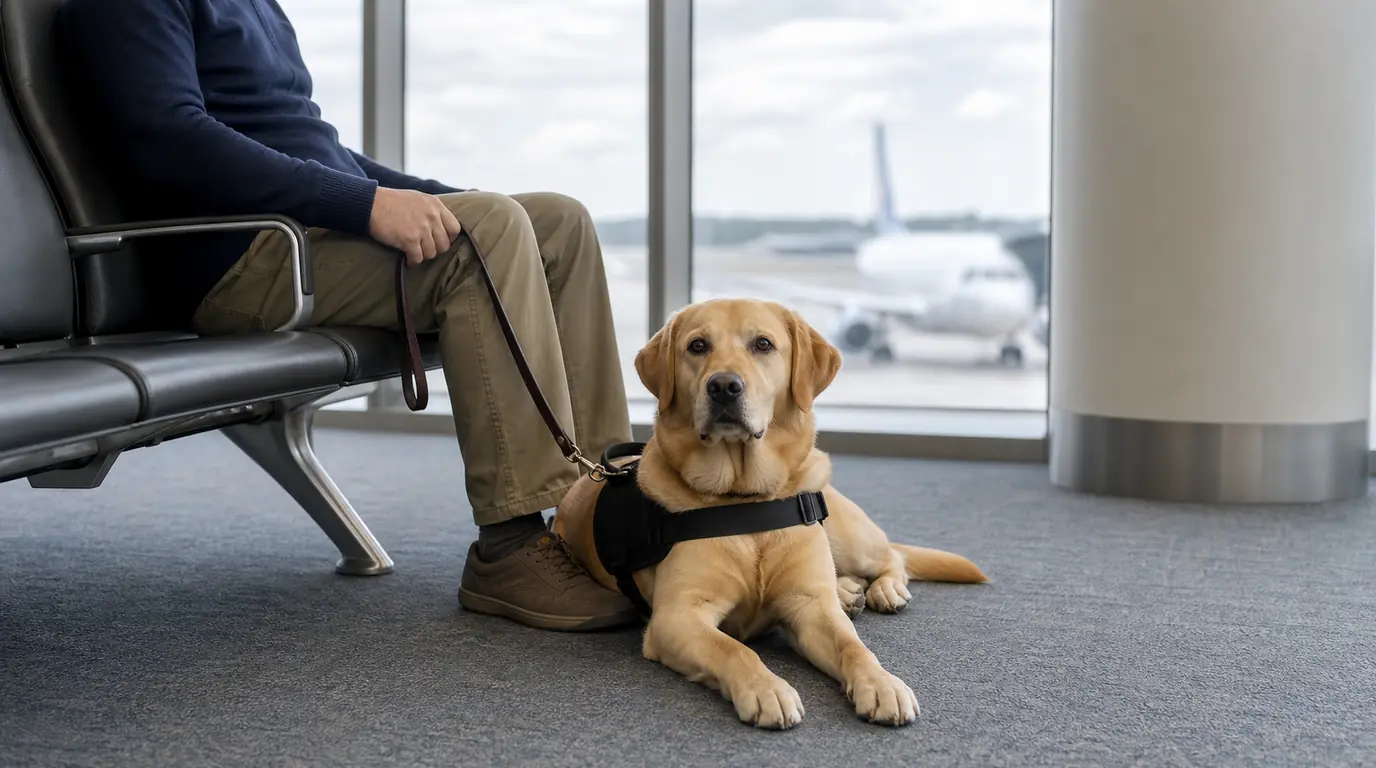
Flying with a service dog requires two separate preparations. The airline must handle the dog under the U.S. Air Carrier Access Act and 14 CFR Part 382. Each destination and transit jurisdiction may also have its own animal-entry rules. An airline form covers only the air-travel accommodation process.
A vest, registration, airline approval, or completed form does not settle every issue. Check whether each operating airline requires the current DOT forms, then submit them through that carrier’s current process. Plan how you will control the dog and meet its relief needs on every flight segment. Before departure, verify the destination, transit, and U.S. return requirements. The information and form status below were checked on July 31, 2026. Forms and entry rules can change, so check current government and airline pages again before travel.
Know the U.S. Definition
Service dog or pet
For U.S. air travel, the rule comes from the Air Carrier Access Act, implemented through 14 CFR Part 382. The DOT service-animal guidance defines a service animal for this purpose as a dog of any breed or type that is individually trained to perform work or tasks for a person with a disability.
The task must relate to the person’s disability. A dog trained to alert a person to a medical condition, interrupt a harmful behavior, retrieve an item, provide balance assistance, or perform another disability-related task may fit the federal air-travel definition. The decision depends on the rule and the dog’s actual training and behavior, not its vest, breed, registration, or appearance.
Pets, emotional-support animals, comfort animals, companionship animals, and service animals in training do not use this same service-dog path under the current U.S. air-travel definition. Non-dog species follow a different route. Airlines may have separate policies for pets or other animals, but those policies are not the Part 382 service-animal process.
This article concerns service dogs in air transportation. It does not cover general airport wheelchair assistance or a separate disability-related seating request. For airport mobility help, use the wheelchair assistance air travel page. For a seat request separate from the dog’s space, use the disability seating accommodations page.
What forms establish
DOT forms collect statements and identifying information. They do not determine whether a person has a disability, train a dog, or make a pet a service animal. A vest, online registration, letter, or commercial document also does not replace the federal definition.
The current DOT Air Transportation Form asks for information about the dog, including its health and rabies vaccination, task training, public behavior, control, and relevant trainer or veterinarian contacts. It also asks about aggressive behavior and whether the handler understands the control requirements, possible charges for damage, and penalties for knowingly false statements.
DOT’s current form page identifies the U.S. DOT Service Animal Air Transportation Form, updated September 20, 2024. Use the live page and the airline’s current instructions rather than an old saved copy. The posted form displays OMB Control No. 2105-0576 and an expiration date of September 30, 2027, but confirm that DOT and the airline have not posted a newer version.
Why a form does not guarantee acceptance
A completed form does not guarantee acceptance. The airline may still assess the dog’s behavior, control, fit in the cabin, safety risk, legal restrictions, and required documents. For the Part 382 service-animal process, however, an airline may not require other service-animal documentation beyond the permitted DOT forms, except documents needed to comply with a federal agency, U.S. territory, or foreign jurisdiction’s animal-transport requirements. A registration or vest does not change those factors.
Under the rule, the airline must make an individualized, objective assessment. General discomfort, fear of a breed, or an assumption based only on breed is not enough; the assessment must consider the type and likelihood of harm and ways to reduce the risk, as described in DOT’s Airline Passengers with Disabilities Bill of Rights.
The handler should provide accurate information and maintain effective control. The airline should base a refusal on a specific permitted ground, not a general impression.
Submit Current DOT Forms
Find every operating airline
Start with the operating carrier, not just the company that sold the ticket. Check the service-animal instructions for every airline operating a segment, including a separate carrier on a connection or code-share itinerary. One airline’s online process may not cover another carrier’s flight.
If a carrier requires a DOT form, it must make the form available on its website in an accessible format. When advance submission is required, it must let the passenger submit either an electronic or hard-copy version. Confirm the carrier’s current receiving process and whether it provides an acknowledgment.
If the airline requires the forms, send them directly to the airline. Do not send them to the Department of Transportation unless DOT requests them during a complaint or inquiry. Keep a copy of each submission, its date and method, and any confirmation number or message.
Complete the air form
Use the live DOT Air Transportation Form page to obtain the current form. Review every field before signing. The form may ask for:
- The dog’s identifying details
- Rabies vaccination and expiration information
- The dog’s health information and veterinarian contact details
- The disability-related tasks the dog performs
- Task-training and public-behavior training
- The handler’s ability to control the dog
- Any relevant aggressive-behavior history
- Task and behavior trainer contacts, where applicable
The form does not require a separate training certificate. It requires truthful statements. The airline or its contractor may contact a listed trainer or veterinarian to verify the information. A handler who trained the dog personally can follow the form’s instructions for providing those details.
Do not alter a saved copy for a new itinerary without checking the current version and airline instructions. If health, vaccination, training, behavior, or itinerary information changes, review whether a new submission is required.
Add the relief attestation
For a flight segment of 8 hours or more, an airline may request the separate DOT Service Animal Relief Attestation Form. The DOT disability resources page identifies the long-segment requirement and current form route.
The attestation asks the handler to explain how the dog will avoid relieving itself on the aircraft or do so without creating a health or sanitation problem. The threshold applies to each segment. An itinerary lasting more than eight hours does not mean every segment reaches the threshold. One nonstop segment can reach it.
For an exactly eight-hour segment, check the airline’s current process and prepare to provide the attestation. DOT guidance and current form treatment use “8 hours or more,” while other public travel wording may differ. Follow the specific current airline and DOT instruction.
Meet the 48-hour window
When a booking is made more than 48 hours before departure, the airline may require the form up to 48 hours before the flight. Submit it as soon as the airline permits instead of waiting for the deadline. This leaves time to correct missing information, resolve problems with the submission route, or confirm coverage for every carrier.
A ticket bought within 48 hours of departure has a different fallback. The airline must allow a completed hard-copy form to be submitted at the gate on the day of travel. Do not treat that option as the preferred plan. Last-minute processing can still create delays, so carry printed copies and check the airline’s instructions before arriving.
If a required form was not submitted in advance, the airline may not simply refuse transportation without trying reasonable efforts to accommodate the passenger. That protection does not remove the obligation to provide accurate forms and cooperate with the carrier’s process.
Confirm trip coverage
An airline may require a form once per trip rather than for every flight. DOT’s form instructions use a round-trip ticket as an example of one trip. That does not establish how a carrier will handle a multi-segment itinerary involving different operating airlines.
Ask whether one submission covers outbound and return segments, connections, code shares, and carrier changes. Record the answer in writing when possible. Carry digital and paper copies of forms, confirmations, itinerary, vaccination information, and airline accessibility-team contacts.
Prepare for Cabin Connections
Forms do not replace a plan for the travel day. The handler remains responsible for supervising, feeding, toileting, and controlling the dog. Connections may add crowded terminals, gate changes, relief needs, and new staff who review the submission.
Plan effective control
The dog generally must be harnessed, leashed, or tethered in the airport and aircraft. Choose a control setup the dog can use safely in security lines, gate areas, jet bridges, and the cabin. Bring the equipment described in the form and use it consistently.
An exception can apply when a tether interferes with the dog’s work or the passenger’s disability prevents its use. The handler must still maintain effective control through voice, signals, or another effective method. This exception does not allow the dog to move freely through the terminal or cabin.
Practice in airport-like conditions, not only in familiar places. The dog should stay under control around lines, food, luggage, wheelchairs, children, and other animals.
Manage relief and behavior
Find airport relief areas before boarding and during each connection. Ask airport or airline staff for directions. Allow enough time to reach the area and return to the gate. If the handler needs help, DOT’s disability guidance recognizes assistance that may include an escort to a service-animal relief area at a U.S. airport.
The relief plan should account for the longest individual segment, not only the total travel day. The handler should understand and follow any relief attestation without creating a sanitation problem.
Behavior also affects the trip. DOT lists significant disruption and misbehavior as possible reasons for refusal. Examples include unprovoked barking or snarling, running around, and jumping on passengers. The dog should settle in a crowded gate area and stay in its assigned space during boarding and the flight.
Fit the cabin space
The dog may use space under the seat in front of the passenger, but it cannot obstruct an aisle, emergency exit, or other safety-critical area. A small dog may sometimes sit on the passenger’s lap when safe. Do not assume a dog can occupy a neighboring seat, block access to an exit, or extend into a walkway.
If the dog is best accommodated at a particular seat, request a bulkhead or other suitable seat in the same class of service. DOT’s disability rights guidance requires that seating accommodation, subject to applicable safety rules and the airline’s seating procedures. The airline does not have to provide a free upgrade or an extra seat, so contact it before travel if the dog’s size makes cabin fit difficult.
Coordinate seats and handoffs
Contact the airline early if a particular seat is needed because of the dog’s size, the passenger’s disability, or safe floor-space requirements. State the service-animal seating need and any separate disability seating need explicitly; do not assume the service-animal form alone creates either seat request.
Allow connection time for relief areas, distant gates, gate changes, form questions, carrier handoffs, and delays. At each handoff, keep the dog with you and under control. Do not assume a gate agent, flight attendant, or connecting carrier has accepted responsibility for the dog’s care.
Check Destination and Return
Review the destination
Part 382 sets the airline’s U.S. air-transportation accommodation process; destination animal-entry law remains separate. A destination may require health certificates, translations, vaccinations, parasite treatments, microchips, antibody titers, permits, quarantine arrangements, or other documents. Some requirements take months to complete.
Use the CDC Yellow Book guidance on pets and service animals as a starting point for health and international travel planning, then check the destination’s current government requirements. Verify whether the jurisdiction recognizes service dogs for entry and whether its rules differ from ordinary pet-entry rules.
Do not wait for the airline to identify an import problem. An airline may accept the dog under its service-animal process while border or animal-health officials still require separate documents.
Check every transit point
Review every country and jurisdiction on the route, including transit points. Rules can apply even if the dog remains inside an airport or aircraft. A connection can create an entry, transit, inspection, or quarantine issue.
Make a route list that includes the departure location, each transit point, the final destination, and the U.S. return point. For each location, record the issuing authority, required documents, vaccination or testing dates, translation rules, and deadlines. Ask the airline whether a schedule change could send the dog through another country.
Plan U.S. re-entry
A dog returning to the United States remains subject to U.S. import requirements, even if it previously lived in the country. The CDC baseline states that every dog entering or returning to the United States must be at least 6 months old, microchipped, healthy on arrival, and accompanied by a CDC Dog Import Form receipt.
Additional requirements depend on the dog’s travel history during the previous 6 months and rabies-vaccination circumstances. Record every country where the dog has been during that period, not only the country where the trip began. Confirm current requirements before leaving the United States because obtaining a missing document abroad can be difficult.
Also check local U.S. rules before departure. Hawaii and Guam can impose added requirements for dogs and cats, including quarantine-related conditions. Airline accommodation, CDC import rules, and local territorial rules are separate checks.
Record Refusals and Escalate
Understand specific refusal grounds
DOT identifies limited grounds on which an airline may refuse transportation of a service dog:
- The dog is too large or heavy to be safely accommodated in the cabin
- The dog poses a direct threat to health or safety
- The dog causes a significant disruption or misbehaves in the cabin or gate area
- Carrying the dog would violate U.S. or foreign law
- The handler fails to provide required current DOT forms.
The airline must use an individualized, objective assessment. It should consider the nature and likelihood of harm and whether mitigation could address the risk. Breed or type alone is not a sufficient basis for refusal, and general discomfort from another passenger or crew member does not establish a valid refusal ground.
If the dog is refused or delayed, ask the employee to identify the specific reason. Do not argue from a vest or commercial registration. Focus on the form, observed behavior, cabin-space issue, legal restriction, or safety concern.
Ask for the CRO
A Complaint Resolution Official, or CRO, is the airline’s specialist for disability accommodations. During airline operating hours, a CRO must be available at no cost, in person or by telephone. Ask for the CRO when gate or customer-service staff cannot resolve a disability-related dispute.
The CRO can review the airline’s handling and explain the carrier’s position. A CRO conversation does not guarantee boarding, reimbursement, or a particular complaint outcome, but it creates a clear escalation point while the event is occurring.
Preserve the travel record
Record these facts as soon as possible:
- Airline, airport, date, and flight number
- The exact reason an employee gave
- Names or descriptions of employees and witnesses
- Observed dog behavior
- When and how each form was submitted
- Boarding documents and messages
- Any requested resolution and the response
Keep copies rather than originals of forms, confirmations, vaccination records, and other supporting documents. Preserve screenshots of submission pages and messages when available. A factual record is more useful than a general statement that the airline “did not allow” the dog.
Use airline and DOT routes
Start with the airline’s complaint or accessibility channel. If the issue concerns disability-related treatment under the Air Carrier Access Act or Part 382, a traveler may also complain to the DOT Aviation Consumer Protection Division using its disability complaint information.
DOT lists useful supporting information, including the carrier, date, location, flight number, people involved, witnesses, a detailed account, and copies of relevant records. For general information or time-sensitive assistance, DOT lists the disability hotline at 1-800-778-4838. A complaint records and reviews the issue but does not promise a particular result. Use the Iliamna Passenger Rights hub to keep the jurisdiction and complaint route visible.
What to check before travel
- Confirm the federal category: For U.S. air travel, the service-animal route concerns a dog individually trained to perform disability-related work or tasks. Pets, emotional-support animals, animals in training, and other species follow different rules.
- Use the airline’s current channel: Check whether each relevant operating airline requires the current DOT forms. If it does, submit them directly and retain copies and confirmations.
- Respect the timing rules: An airline may require advance submission up to 48 hours before departure when the booking was made earlier. A booking within 48 hours has a gate-day hard-copy fallback.
- Plan each segment: Check whether any individual flight is 8 hours or more, prepare the relief attestation if requested, and arrange control, relief, cabin space, seating, and connection time.
- Separate airline access from entry law: Verify the destination, every transit point, and U.S. return requirements, including the six-month travel-history review and CDC Dog Import Form receipt.
FAQ
Is an emotional-support animal covered by the service-dog flight process?
The current DOT air-travel definition does not classify an emotional-support, comfort, or companionship animal as a service animal. The animal must follow the airline’s applicable pet or other policy.
Where do I send the DOT form?
If the operating airline requires the form, send it directly through that airline’s current service-animal submission route. Do not send the routine form to the Department of Transportation.
When should I submit the form?
If the reservation was made more than 48 hours before departure, the airline may require submission up to 48 hours before the flight. Submit it earlier when the airline allows and keep the confirmation.
What happens if I booked within 48 hours?
The airline must allow a completed hard-copy form to be submitted at the departure gate on the day of travel. Treat that as a fallback and confirm the carrier’s process before going to the airport.
When can the relief attestation apply?
An airline may request the separate relief attestation for a flight segment of 8 hours or more. Check the duration of each segment, not only the total itinerary.
Does the current DOT form require a separate training certificate?
No. The current Air Transportation Form does not require a separate training certificate. It requires attestations about task training, behavior, control, and other information, including trainer or training-organization contact details where applicable.
Can the dog sit in the aisle or block an exit?
No. The dog may use the space under the seat in front of the passenger, but it cannot obstruct an aisle, emergency exit, or another required clear area. A small dog may sometimes sit on a lap when safe.
Does airline approval satisfy foreign-entry requirements?
No. Airline accommodation and animal-entry law are separate. Check the destination, every transit jurisdiction, and U.S. re-entry requirements before departure.