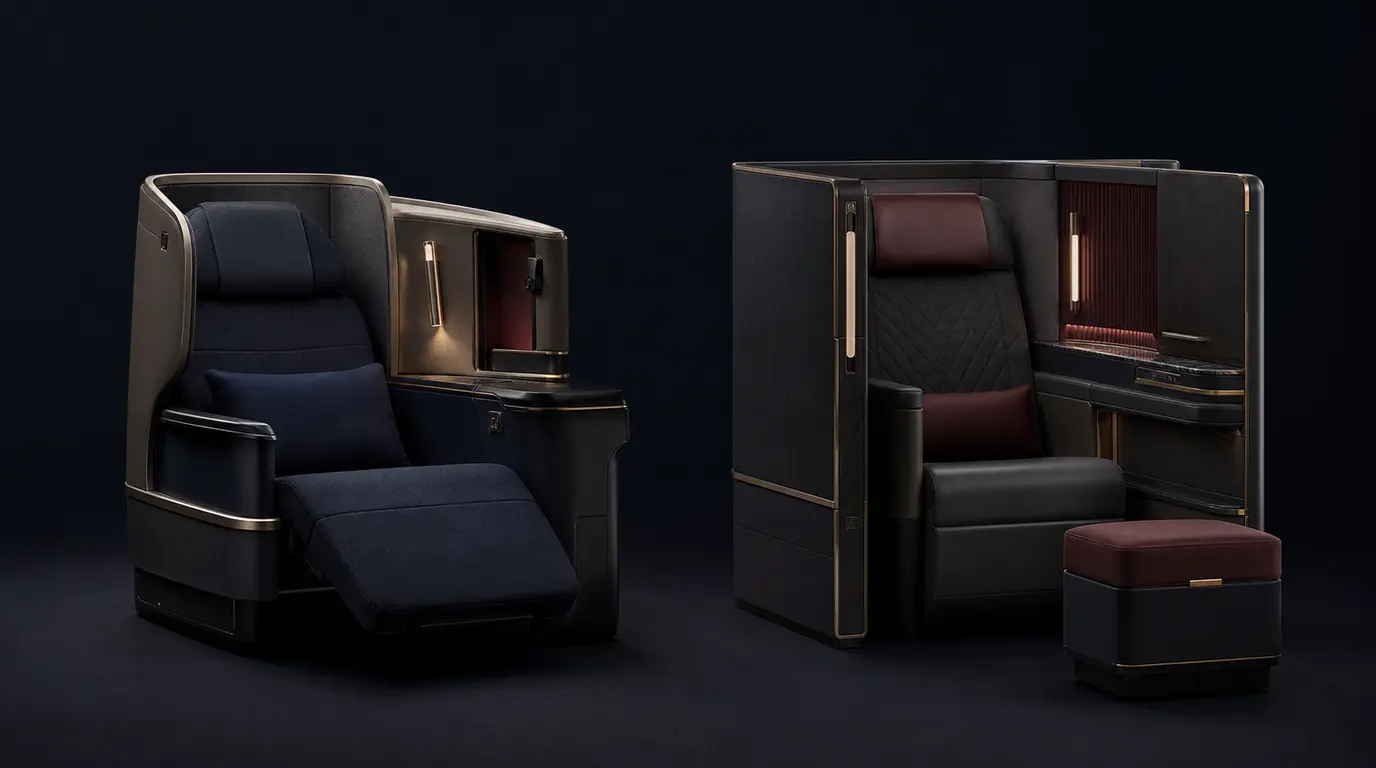
First Class and Business Class are airline product labels, not universal specifications. On one flight, First may be a separate cabin above Business. On another, Business may be the highest cabin sold. The useful comparison is therefore not the label alone. It is the installed seat, privacy, service, airport benefits, baggage terms, fare rules, and every segment of the itinerary.
Start with the exact flight, date, operating carrier, and aircraft shown for each segment. Then compare only benefits that the fare or airline record actually confirms. If a detail is missing, mark it unconfirmed instead of filling the gap with an assumption about what First or Business normally includes.
Start with the whole itinerary
A premium-cabin comparison can go wrong before the seat comparison begins. A search result may show one cabin label for a journey containing several flights, even though the product changes between segments. A long flight may use one aircraft and seat type, while a shorter connection uses a different cabin, layout, or operating carrier.
Build a segment list before judging the offer:
- flight number and date
- marketing carrier and operating carrier
- aircraft type or configuration shown
- cabin sold on that segment
- seat assigned or selectable
- fare family or booking terms
- baggage allowance and fees
- airport benefits explicitly included
This prevents the strongest segment from standing in for the whole trip. A private seat on one flight does not describe a connecting flight that uses a recliner, a different carrier, or a different fare record. The same principle applies to ground benefits: lounge access or priority services attached to one segment should not be assumed to continue throughout the itinerary.
For a repeatable method, put the segment records side by side in a flight comparison sheet rather than comparing headline labels.
Confirm who operates each flight
The airline whose code appears first is not always the airline flying the aircraft. In a code-share, a marketing carrier can sell a flight operated by another carrier. US code-share disclosure rules require the transporting carrier’s identity to be disclosed in specified schedule, itinerary, and confirmation contexts.
Look for an “operated by” statement on every segment. The operating carrier matters because its aircraft, crew, cabin configuration, and onboard procedures apply to that flight. The marketed cabin name does not override those operational facts.
Different carrier names do not automatically make an itinerary worse, and the same carrier name does not make every segment consistent. The point is to identify which product record governs each flight before comparing it.
Treat the aircraft as provisional
Check the aircraft and configuration shown for the exact flight and date, but do not treat an advance assignment as a promise. Equipment can change. Save the date of the check and revisit it before travel.
An aircraft family name may also be too broad. One airline can operate multiple configurations within the same family, with different row counts or premium seats. Compare the seat map’s row and letter pattern with the airline’s configuration page when possible. The guide to reading a seat map explains how to keep the displayed layout separate from the final aircraft.
Compare the installed seat
The physical seat is usually the largest difference a traveler expects between First and Business, but the cabin name cannot establish it. Compare the specific seat installed on the specific aircraft.
Useful seat questions include:
- Does it recline to a bed, a deep recline, or a standard seated position?
- Is the sleeping surface fully flat, angled, or not intended as a bed?
- Does every seat have direct aisle access?
- Is the seat enclosed, partly screened, or open to the aisle?
- How much personal storage is described?
- Are power, a table, or entertainment controls shown for that configuration?
- Is a companion arrangement available, and does it affect privacy?
Do not translate a marketing phrase into a measurement it does not provide. “Suite,” “pod,” “lie-flat,” and similar terms still need confirmation against the airline’s product and aircraft records. Photos can help identify the layout, but a promotional cabin image may not depict the aircraft assigned to the flight.
Seat assignment is a separate record again. A fare can include access to a cabin without confirming a particular seat. US rules list advance seat selection and seat upgrades among optional services, but that does not mean they are always charged separately. It means the fare terms must settle whether selection is included, paid, restricted, or unavailable for this booking.
Compare privacy and service separately
Privacy depends on the installed layout, not only on the cabin. A door can increase visual separation, but direct aisle exposure, seat orientation, companion dividers, and proximity to a galley or lavatory can also affect the experience. Compare what the layout actually shows and avoid assuming that First is always enclosed or that Business is always open.
Service is another independent category. Check the operating carrier’s current description for the route and cabin. Look for what is stated about meals, drinks, bedding, amenity items, and service timing. Do not infer a menu, brand, quantity, or availability from an old review or from the cabin label.
US fee-disclosure rules include food, drinks, pillows, blankets, advance seat selection, upgrades, and baggage within the broad category of optional services that may carry separate fees. A service may be bundled with a particular fare, sold separately, or not offered. Read the actual inclusion record before assigning value to it.
The distinction also helps when preferences differ. A traveler who prioritizes sleep may care most about bed geometry and privacy. Someone working during the flight may care more about power, table space, and aisle access. A companion pair may value a layout that allows conversation. There is no useful universal ranking without deciding which verified features matter for that trip.
Check airport and ground benefits
Premium travel can include benefits before boarding or after landing, but the label alone does not confirm them. Review each benefit as a yes, no, or unconfirmed record:
- priority check-in
- priority security where offered
- lounge access
- priority boarding
- priority baggage handling
- arrival lounge access
- ground transfer or chauffeur service
Then check the scope. A benefit may depend on the airport, fare, status, operating carrier, marketing carrier, or time of travel. Lounge access may also depend on the departing segment rather than the cabin used earlier in the journey. Never assume that a benefit shown for one airport or route applies globally.
Ground services are particularly vulnerable to vague comparison language. “Premium airport experience” is not a usable record. The comparison should name the exact service, the airport where it applies, the eligible segment, and the source that confirms it. If any one of those is missing, leave the benefit unconfirmed.
Read fare and baggage terms
The more expensive-looking cabin is not necessarily the more flexible fare. Airlines can sell multiple fare families within the same cabin, with different change, cancellation, refund, seat-selection, upgrade, and mileage terms.
Compare the fare rules directly:
- refundable or nonrefundable status
- change conditions and any stated fee
- cancellation and credit conditions
- missed-flight or no-show consequences
- advance seat-selection terms
- upgrade or downgrade treatment
- mileage or status-credit terms, if relevant
Do not reduce these records to “flexible” unless the booking terms define what that means. A Business fare with favorable change terms can fit one trip better than a more restrictive First fare, even if the latter has the stronger onboard product.
Keep baggage separate
Baggage allowance follows the ticket and applicable carrier rules, not a general cabin stereotype. For covered itineraries, the US fee rule requires e-ticket confirmations to include the free baggage allowance and carry-on, first checked bag, and second checked bag fee information. It also requires marketing carriers in covered code-share travel to disclose specified differences between their optional services and fees and those of the operating carrier.
Record the allowance for every segment, including piece count, weight or size conditions, and any carrier change. The guide to reading an airline baggage allowance provides a separate method for that check.
Allowance is different from permission to pack an item. FAA PackSafe guidance distinguishes hazardous-materials rules from TSA security screening and warns that airline and international requirements may be more restrictive. A premium baggage allowance does not make a restricted item acceptable.
Keep accessibility and safety out of the upgrade comparison
Accessibility accommodations and exit-row duties are governed by their own processes. They should not be presented as premium-cabin perks.
Under US rules, carriers must provide specified seating accommodations for passengers with disabilities on request when the conditions in the rule are met and the relevant seat exists on the aircraft. Examples include certain movable-armrest, assistant, service-animal, and fused-leg accommodations.
The related seating requirements make clear that this obligation does not require more than one seat per ticket or a class of service other than the one purchased. A traveler should route an accommodation request through the operating carrier’s accessibility process rather than trying to solve it by choosing First or Business.
Exit-row seating is a safety assignment, not a premium feature. The governing exit-seating regulation sets suitability, function, instruction, and reseating requirements. FAA passenger safety guidance says an exit-row occupant must be physically capable of and willing to perform the required emergency actions. Extra space does not remove those duties.
Decide whether the difference matters
Once the records are complete, compare the incremental difference rather than asking which label wins.
First, identify what both options share. If the operating carrier, aircraft, lounge, baggage allowance, or flexibility is the same, remove that item from the decision. Next, list the differences that remain. Give each one a value based on the actual trip, not on prestige.
Questions that make the comparison concrete include:
- Is the seat meaningfully different for the hours spent onboard?
- Does the privacy difference matter when sleeping, working, or traveling with a companion?
- Are the service differences confirmed and relevant?
- Do airport benefits save effort at the airports in this itinerary?
- Are baggage and fare rules better, worse, or simply different?
- Does the stronger product apply to every important segment?
- What happens to the comparison if the aircraft changes?
The flight-comparison method is useful when cabin quality must be weighed against schedule, stops, and connection risk. A superior seat on one segment may not compensate for a poor itinerary, while a modest cabin difference may be worthwhile on the longest overnight flight.
Recheck before relying on the answer
Save the sources and date used for the comparison. Recheck after an aircraft change, schedule change, operating-carrier change, or ticket reissue. These events can alter the layout, seat assignment, baggage record, or included services.
If a detail remains unconfirmed, preserve that status in the final comparison. “Unknown” is more useful than a confident guess because it shows where a decision still carries risk.
First Class is not automatically better than Business Class, and Business Class is not one consistent product. The defensible choice comes from the exact itinerary: operating carrier, aircraft, installed seat, privacy, service, ground benefits, fare, baggage, and segment coverage. Compare those records, then decide whether the verified difference is valuable for the traveler and trip in question.
FAQ
Is First Class always above Business Class?
No. Airlines use cabin labels differently, and some flights do not offer both. Check the cabin structure and installed product for the exact operating carrier, aircraft, route, and date.
Does either cabin always include lounge access?
No. Lounge access can depend on the fare, operating or marketing carrier, airport, departure segment, and other eligibility rules. Confirm the benefit for the exact itinerary.
Does a premium-cabin ticket guarantee a particular seat?
It confirms the cabin sold under the ticket terms, but a specific seat assignment or free advance selection may be a separate record. Check the seat status and fare rules.
Can a connection have a different premium product?
Yes. Each segment can have a different operating carrier, aircraft, layout, and cabin. Compare the segments separately and note where the advertised product actually applies.
Is a First Class fare necessarily more flexible?
No. Flexibility follows the fare rules, not the cabin name alone. Compare refund, change, cancellation, no-show, and ticket-credit terms for the exact fares.
Should an exit-row seat be treated as a premium upgrade?
No. An exit row has safety-related suitability and assistance duties. Use the map to locate it, then apply the carrier and regulatory process separately from a comfort comparison.